



Autor: Thierry Julien, CEO, TJC Group
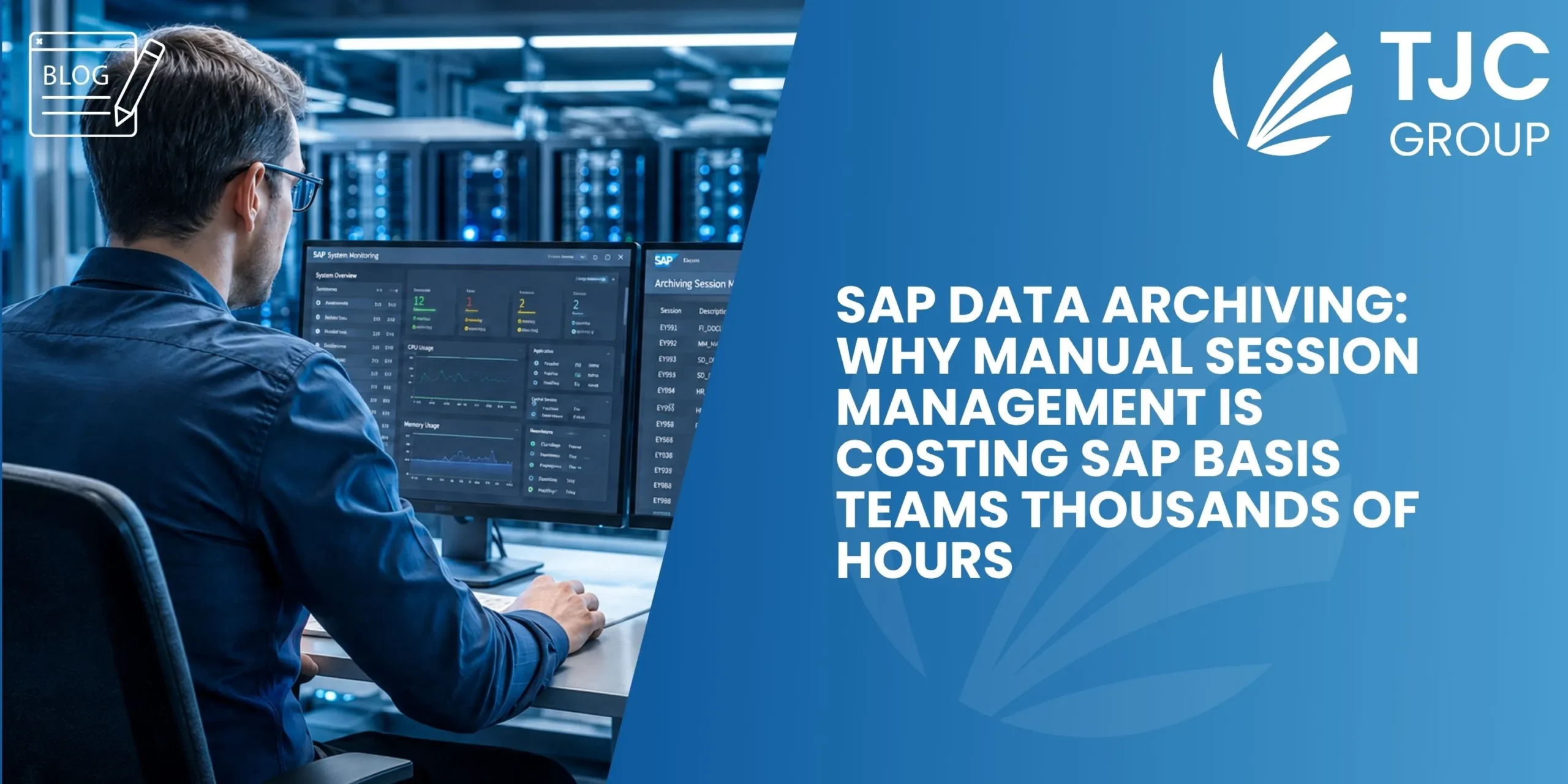
SAP transaction SARA has been the standard tool for data archiving administration for decades. Yet as data volumes grow exponentially and organisations face mounting pressure to keep SAP systems lean, especially ahead of S/4HANA migrations, SARA’s manual, session-by-session approach is proving increasingly inadequate. In this article, we examine why SARA falls short of true archiving automation and how TJC Group’s Archiving Sessions Cockpit (ASC) fills the gap.
Table of contents
Introduction
Data archiving is not a one-off project. It is a continuous, recurring discipline. Every day, SAP systems generate new transactional data: purchase orders, invoices, material documents, change logs, and more. Left unmanaged, this data accumulates relentlessly, degrading system performance, inflating storage costs, and complicating migrations.
SAP provides transaction SARA (Archive Administration) as its native tool for managing archiving runs. Combined with the Archive Development Kit (ADK), SARA has served as the backbone of SAP data archiving for years. However, SARA was designed as an administration interface, not an automation engine.
The distinction matters enormously. Administration means a human operator must plan, configure, schedule, monitor, and troubleshoot each archiving session manually. Automation means the system handles these tasks independently, consistently, and without interruption. As organisations scale their archiving efforts across dozens of archiving objects, hundreds of company codes, and multiple SAP systems, the gap between administration and automation becomes a critical bottleneck.
What is the Archiving Sessions Cockpit (ASC)?
The Archiving Sessions Cockpit (ASC) is TJC Group’s proprietary software solution designed specifically to automate and orchestrate the entire SAP data archiving process. Developed in response to repeated customer requests for a way to eliminate the manual burden of recurring archiving, ASC manages and controls all archiving runs from a single point of control.
ASC does not replace SARA or the ADK. It builds on top of them. It uses SAP’s standard archiving infrastructure but adds an intelligent automation layer that handles everything SARA cannot: session planning, variant generation, scheduling, execution, monitoring, error recovery, and reporting.
Core functions of ASC, just to name a few
Automated mass archiving: ASC automates initial, regular, and selective archiving runs across all configured archiving objects, without manual intervention.
Business calendar synchronisation: Archiving sessions are scheduled in alignment with IT maintenance windows and business calendars, ensuring zero disruption to daily operations.
End-to-end session management: ASC manages all phases of each archiving run, write, delete, and store, through to completion, including managing dependencies between phases.
Automatic error recovery: If a session is interrupted by a system issue or error, ASC automatically recovers and restarts the session, eliminating the need for manual troubleshooting.
Fine-grained variant management: ASC can manage detailed archiving variants with granular selection criteria, dynamically generating the appropriate variants for each session based on rules rather than static values.
Traceability and audit logging: Complete logs are maintained for every session, providing full traceability for compliance and audit purposes.
SARA vs. ASC: A detailed comparison
The following comparison highlights the key differences between relying on SARA alone and augmenting it with the Archiving Sessions Cockpit:
|
Capability |
SARA (native) |
ASC (TJC Group) |
|
Session scheduling |
Manual, per-object scheduling via SAP job scheduler |
Automated scheduling across all objects, including several systems, synchronised with business calendars |
|
Variant management |
Static variants; manual adaptation required for fiscal periods, number ranges, or residence times |
Dynamic variant generation based on configurable rules; no manual adaptation needed |
|
Multi-object orchestration |
No built-in orchestration; each object managed independently |
Centralised orchestration of all archiving objects in a defined sequence |
|
Error handling |
Manual identification and restart required |
Automatic recovery and restart of interrupted sessions |
|
Business calendar awareness |
None; scheduling must be manually coordinated |
Built-in alignment with IT schedules and business calendars |
|
Consolidated monitoring |
Per-session logs only; no holistic dashboard |
Single-point monitoring of all archiving runs and their status |
|
Recurrent archiving |
Requires manual re-execution of each session |
Fully automated recurring sessions at defined intervals |
|
Scalability |
Effort scales linearly with the number of objects and company codes |
Effort remains limited regardless of archiving scope |
|
Traceability |
Basic job logs |
Comprehensive traceability logs for audit and compliance |
|
Sustaining long-term gains |
No mechanism to ensure continuity after initial project |
Automated recurrence ensures gains are retained permanently |
In summary, SARA provides the technical foundation for archiving, while ASC provides the automation, orchestration, and intelligence needed to make archiving a sustainable, enterprise-grade process.
Why full automation matters more than ever
Several converging trends make the case for automated archiving more compelling than ever before.
S/4HANA migration pressures
The ongoing migration wave from SAP ECC to S/4HANA has made data volume and memory management a strategic priority. S/4HANA runs on an in-memory database (HANA), where every gigabyte of data directly impacts infrastructure costs. Reducing data volumes before migration shortens conversion times, lowers hardware requirements, and reduces project risk.
However, pre-migration archiving is not exactly a one-time exercise. Data continues to accumulate during the migration planning phase, which can span 12 to 24 months. Without automated archiving running continuously throughout this period, the volumes that were painstakingly reduced will grow back, undermining the very purpose of the exercise.
IT resource constraints
Skilled SAP Basis administrators and ILM lead consultants are a scarce resource. Dedicating them to the repetitive, manual task of managing archiving sessions is neither efficient nor sustainable. Automation frees up these valuable resources to focus on higher-priority initiatives such as system optimisation, security, and innovation, also making sure ILM is running efficiently over time (focus on archiving ratio).
The cost of inaction
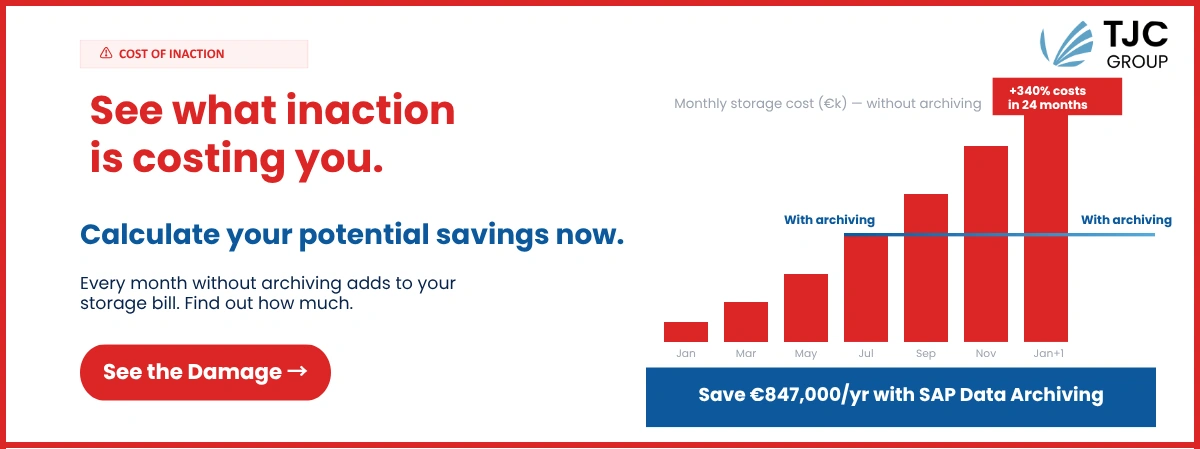
Failing to archive regularly has tangible financial consequences. Database growth increases storage costs, degrades system performance (leading to longer batch processing times and slower user response times), and complicates system upgrades. For organisations running HANA, the cost impact is even more pronounced, as in-memory storage is significantly more expensive than traditional disk-based storage.
Real-world impact: What ASC delivers in practice
Organisations that have adopted the Archiving Sessions Cockpit have achieved remarkable results. Customers using ASC have reported archiving rates exceeding 95% to 99%, a figure that is difficult to achieve and virtually impossible to sustain with manual archiving alone.
Beyond the initial database reduction, ASC’s true value lies in its ability to maintain those gains over time. By running automated, recurring archiving sessions (monthly, weekly, or at whatever cadence the organisation requires), ASC ensures that data volumes remain under control permanently, rather than rebounding after the project team disbands.
Key takeaways
SAP transaction SARA remains a necessary and capable tool for executing individual archiving sessions. However, it was never designed to deliver the full automation that modern SAP environments demand. Here are the essential points to remember:
- SARA is an administration tool, not an automation engine. It requires manual intervention at every stage, from variant creation to scheduling, monitoring, and error recovery. For occasional, small-scale archiving, this may be acceptable. For enterprise-wide, recurring archiving, it is not.
- Manual archiving does not scale. As the number of archiving objects, company codes, and systems grows, the effort required to manage archiving through SARA alone increases linearly. Automation keeps the effort limited and constant regardless of scope.
- Gains from archiving projects are temporary without automation. An initial archiving project may achieve impressive database reductions, but without automated recurrence, data volumes will grow back within months. ASC ensures that archiving gains are sustained permanently.
- Automation reduces compliance risk. Consistent, rule-based archiving ensures that data retention policies are applied uniformly, reducing the risk of regulatory non-compliance.
- The Archiving Sessions Cockpit complements SARA; it does not replace it. ASC builds on SAP’s standard archiving infrastructure, adding the orchestration, intelligence, and automation layer that SARA lacks. Together, they form a complete, enterprise-grade archiving solution.
If your organisation is struggling with the manual burden of SAP data archiving, or if you are planning an S/4HANA migration and need to bring data volumes under control, TJC Group can help. With over 25 years of expertise in SAP data volume management and a proven automation solution in the Archiving Sessions Cockpit, we empower organisations to take control of their data landscape, once and for all. Contact us to learn more.