



Author: Thierry Julien, CEO at TJC Group
Early data deletion can be just as risky as retaining it for too long. While data privacy regulations require organisations to remove unnecessary data, legal and tax obligations often mandate longer retention periods. Effective information lifecycle management balances compliance, retention and destruction. Discover how SAP ILM and TJC Group’s Archiving Sessions Cockpit help organisations automate data governance, reduce risk and maintain compliance.
Table of contents
- Introduction
- Reasons to destroy data in SAP systems
- Real-world examples of data deletion
- The right balance: Data privacy and compliance
- Key takeaway
- ASC with ILM and Data Deletion Management
- Operational risks without automated ILM
- The cost of non-compliance: A €42 million lesson
- Real-world success stories
- Key value proposition of the ASC for ILM
- Conclusion
Introduction
Many organisations delete large volumes of data for privacy reasons. The intention is understandable. Regulations such as GDPR , Law 25 and other data protection frameworks require organisations to ensure personal data is not retained indefinitely. As a result, many businesses assume that deleting data as quickly as possible is the safest approach. Unfortunately, that assumption can create significant compliance risks.
Data privacy regulations do not override legal retention obligations. In fact, many tax, accounting and regulatory frameworks require organisations to retain records for years after their original business purpose has ended. If critical financial, transactional or operational data is deleted prematurely, organisations may find themselves unable to defend their position during audits, investigations or legal proceedings.
For example, French tax regulations may require certain records to be retained for up to ten years in specific audit or judicial circumstances. Similar extended retention requirements exist in many jurisdictions worldwide. Data deletion after three or five years without considering these obligations can expose organisations to serious compliance failures.
The challenge is therefore not simply deciding when to delete data. It is managing the entire SAP ILM (information lifecycle) correctly.
Reasons to destroy data in SAP systems
There are a few reasons to destroy data:
Legal and regulatory compliance
Data privacy laws establish that data must be destroyed when the original use for that data has outlived its purpose. Once the legal retention period has been reached, the data must be deleted to remain compliant.
Although retention principles are similar across jurisdictions, exact requirements vary according to country, industry and data type.
For example, a document may need to be retained for seven years in the United Kingdom, while the same document type may require ten years of retention in France. Managing these differences manually becomes increasingly difficult for multinational organisations.
The original purpose no longer exists
Obsolete, irrelevant or duplicate records no longer contribute to business operations or decision-making. Maintaining such information creates unnecessary complexity and governance challenges.
Examples include historical company codes, discontinued products or outdated organisational structures that no longer serve a business purpose.
Removing unnecessary data improves overall data quality and strengthens governance processes.
Performance and cost efficiency
Many SAP customers experience performance issues caused by growing data volumes in SAP ECC and SAP S/4HANA environments.
Large databases can slow reporting, backups, upgrades and financial closing processes. They also increase infrastructure and storage costs.
Archiving and destroying data according to a structured lifecycle strategy helps organisations reduce database volumes, improve performance, simplify administration and prepare for projects such as SAP S/4HANA transformations and cloud migrations.
Real-world examples of data deletion
Data destruction requirements arise in various business contexts.
Scenario 1: Data Privacy compliance
To comply with data privacy requirements around the world, personal data must be deleted when the purpose of that data has expired or when the individual has requested it. Data must be deleted from live systems and from any backup
Scenario 2: Corporate carve-out
When an organisation divests a subsidiary, data related to that entity may no longer serve any business purpose. Once retention requirements have been satisfied, the information becomes eligible for destruction.
Scenario 3: Product discontinuation
A telecommunications provider discontinues specific products or services. Historical records relating to these products may be destroyed once all legal and regulatory obligations have expired.
Scenario 4: Contract termination
Customer and supplier contracts often generate long-term retention obligations. Once statutory reporting requirements and legal defence periods have expired, the remaining information may become eligible for destruction.
Scenario 5: Employee departure
Human resources records typically require retention for several years after employment ends. Following the applicable retention period, destruction of personal data and other retained data becomes both permissible and, in many cases, mandatory.
The right balance: Data privacy and compliance
The answer to this doesn’t lie in early data deletion. Instead, organisations should focus on balancing privacy requirements with legal retention obligations.
In SAP environments, this means:
- Archiving data to reduce database volumes and improve system performance.
- Restricting the use of personal data where required.
- Applying controlled destruction only after retention periods have expired.
- Maintaining full traceability and auditability throughout the process.
The objective is simple: retain what must be retained and destroy what should be destroyed.
Key takeaway
Early data deletion is not data privacy compliance. In many cases, it is non-compliance. True data governance means:
- Keeping what must be kept.
- Deleting only what must be deleted.
- Applying retention policies consistently.
- Automating and documenting every step.
This is where TJC Group combines expertise and technology to help organisations achieve both compliance and operational efficiency.
ASC with ILM and Data Deletion Management
The Archiving Sessions Cockpit (ASC) is an SAP-certified solution that automates the complete SAP data archiving and information lifecycle management process, from archive file creation through to compliant data destruction.
The solution is available in two editions:
- ASC Standard Edition, focused on traditional SAP data archiving and database volume reduction.
- ASC for ILM, which combines data archiving and controlled data destruction in line with SAP Information Lifecycle Management principles and regulatory requirements such as GDPR.
The ASC ILM Edition extends traditional archiving by introducing structured, automated and auditable destruction processes.
Built on SAP ADK principles and aligned with SAP SARA and SARI standards, ASC integrates seamlessly into SAP landscapes, including SAP S/4HANA Cloud Private Edition and RISE with SAP environments.
Operational risks without automated ILM
Managing retention and destruction manually introduces significant operational and compliance risks.
Common challenges include:
- Manual configuration errors leading to incorrect data selection.
- Accidental deletion of objects without defined retention periods.
- Missed destruction deadlines creating compliance exposure.
- Inconsistent application of retention policies across countries.
- Misalignment between legal obligations and technical execution.
- Limited audit evidence for regulatory reviews.
As data volumes and regulatory requirements continue to grow, manual processes become increasingly difficult to sustain.
The cost of non-compliance: A €42 million lesson
In March 2026, the CNIL (French data privacy authority) imposed a €42 million fine on a telecommunications company following a cyberattack and customer complaints.
The sanction was not based solely on the security incident itself. A major contributing factor was the organisation’s failure to effectively delete personal data that should no longer have been retained.
The case highlights an important compliance reality.
Retaining data beyond its legal retention period is not a neutral act. It increases exposure during security incidents and may constitute a compliance violation in its own right.
For SAP customers, the lesson is clear. Retention policies cannot remain theoretical. They must be translated into operational processes that consistently enforce both retention and destruction requirements.
Automation is essential to achieving that objective.
Real-world success stories
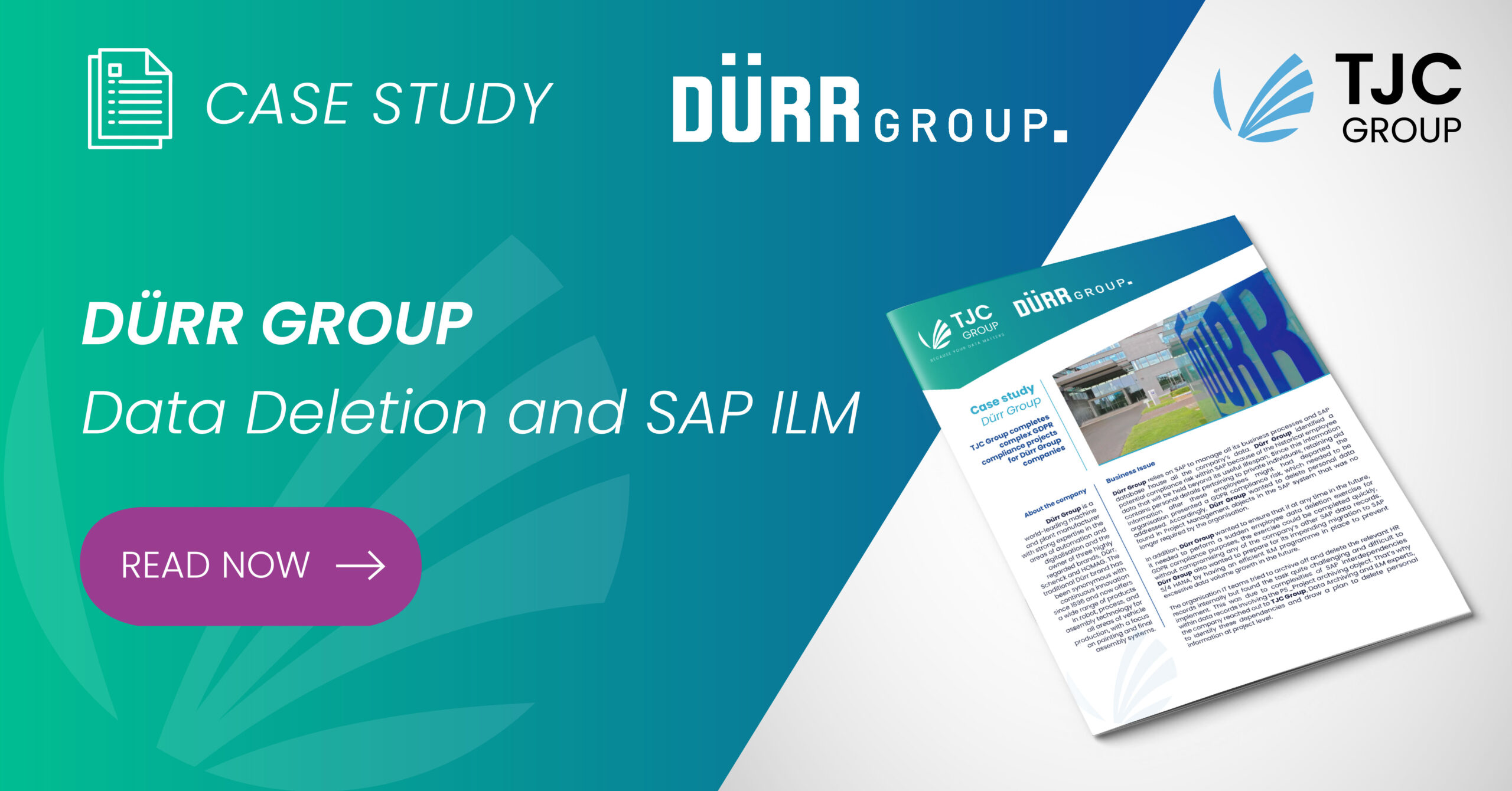
Dürr Group: Achieving GDPR compliance
Before GDPR came into force, Dürr Group had never needed to implement structured data deletion processes within SAP.
To address the new regulatory requirements, TJC Group helped identify SAP data dependencies, prepare records for deletion, implement archiving and ILM processes, and automate future compliance activities using ASC.
The result was a reliable and repeatable framework for compliant data destruction, reducing risk while maintaining operational efficiency.
Carlsberg Group: A long-term data lifecycle management strategy
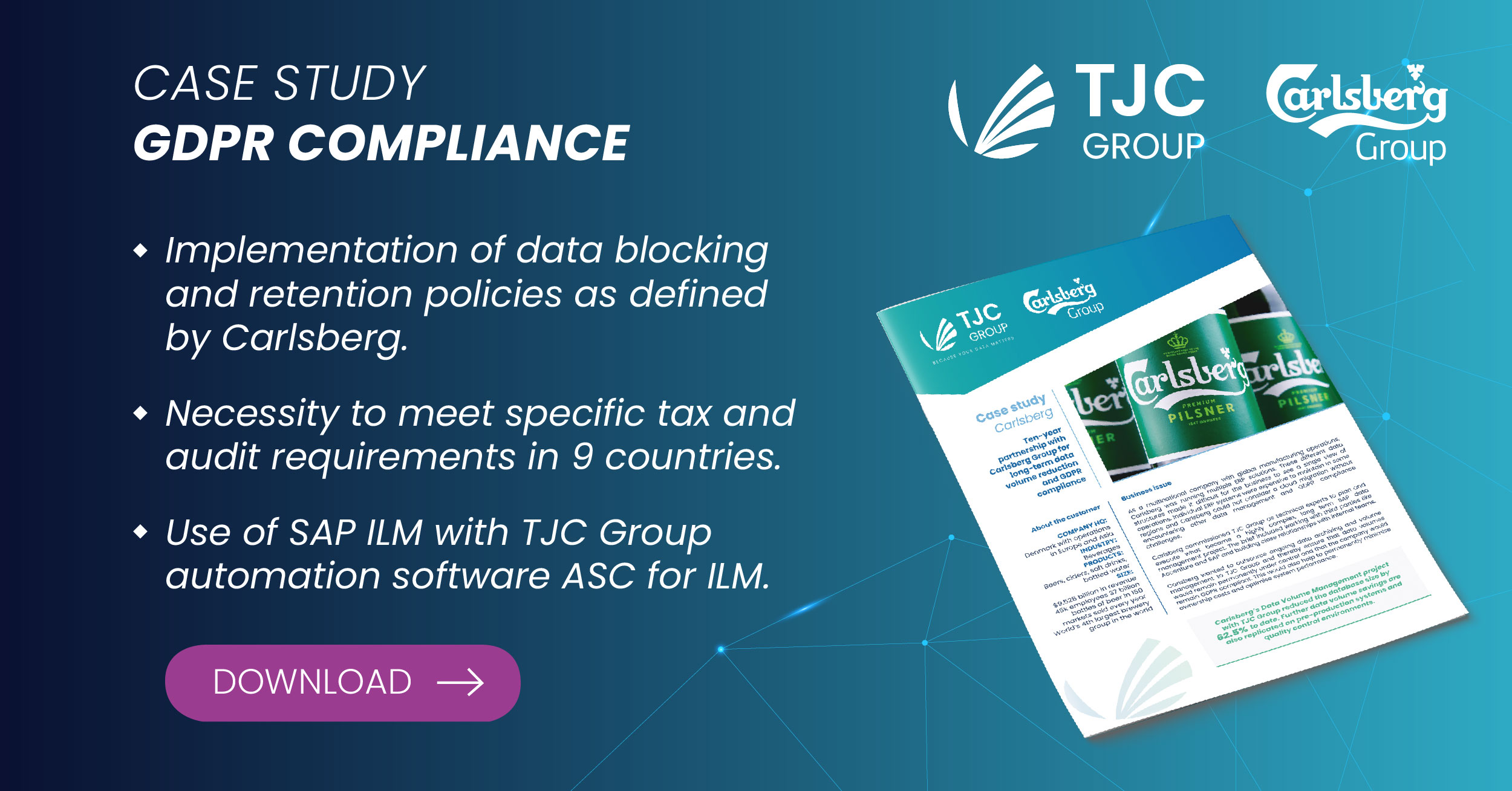
Over a partnership spanning more than ten years, TJC Group has supported Carlsberg Group’s journey from traditional archiving initiatives to a comprehensive data lifecycle management strategy.
The programme included large-scale SAP archiving, implementation of SAP ILM, country-specific retention rules and automated destruction processes.
Among the key achievements:
- Closure of 99.89% of open items in preparation for SAP S/4HANA migration.
- Reduction of database size by 62.5%.
- Significant reductions in storage requirements and associated carbon emissions.
The project demonstrates how organisations can combine compliance, operational efficiency and sustainability through effective lifecycle management.
Key value proposition of the ASC for ILM
The Archiving Sessions Cockpit transforms SAP ILM from a theoretical framework into operational reality.
Key capabilities include:
- Centralised management of archiving and destruction activities.
- Automated generation of highly granular selection variants.
- Support for retention management across ILM and non-ILM objects.
- Country-specific retention and destruction logic.
- Protection against unintended global deletions.
- Flexible exclusions for audits and legal constraints.
- Reduced manual effort and administrative complexity.
Once configured, ASC operates largely in the background, enabling organisations to maintain compliance with minimal ongoing intervention.
Conclusion
Early data deletion can create compliance risks. The challenge for organisations is not choosing between retention and destruction. It is managing both correctly.
Effective information lifecycle management requires organisations to retain data for as long as necessary, destroy it when legally required and maintain complete visibility throughout the process.
By combining SAP-certified technology with more than 25 years of SAP data management expertise, TJC Group helps organisations transform retention policies into automated, controlled and auditable processes.
Because compliance is not about deleting everything. It is about keeping what must be kept, deleting what should be deleted and proving every decision along the way.
FAQ's
Q1. Why is deleting data too early considered a compliance risk?
Answer:
Deleting data prematurely can violate legal and tax retention obligations. While data privacy laws such as GDPR require organisations to remove unnecessary personal data, many jurisdictions mandate that financial, transactional and operational records be retained for years. In short, data privacy laws do not override legal retention obligations, which differ by country and industry. Early data deletion can leave organisations unable to defend their position during audits, investigations or legal proceedings.
Q2. How does SAP ILM help organisations balance data privacy and retention requirements?
Answer:
SAP Information Lifecycle Management (ILM) provides a structured framework for managing the entire data lifecycle. It enables organisations to archive data to reduce database volumes, restrict the use of personal data where required and apply controlled destruction only after all applicable retention periods have expired, ensuring both privacy compliance and legal retention obligations are met.
Q3. What is the Archiving Sessions Cockpit (ASC) and how does it support data deletion management?
Answer:
The Archiving Sessions Cockpit (ASC) is an SAP-certified solution developed by TJC Group that automates the complete data archiving and information lifecycle management process. The ASC is based on SAP classical ADK principles and works in combination with SAP ILM. The ASC for ILM edition combines data archiving with controlled, auditable data destruction, supporting country-specific retention rules. It integrates seamlessly into SAP S/4HANA and RISE with SAP environments.
Q4. What are the risks of managing data retention and destruction manually?
Answer:
Manual management of retention and destruction introduces significant risks, including configuration errors leading to incorrect data selection, accidental deletion of records without defined retention periods, missed destruction deadlines, inconsistent application of policies across countries and limited audit evidence. As data volumes and regulatory requirements grow, manual processes become increasingly unsustainable and expose organisations to compliance failures.