



Author: Patchanok Kluabkaew, B2G Team Lead
E-invoicing in 2026 has reached a decisive tipping point. With over 60 countries now enforcing or actively rolling out mandatory electronic invoicing legislation, the shift from paper-based and PDF invoicing to structured, machine-readable formats is no longer optional. For businesses operating across borders, understanding the e-invoicing benefits on offer is essential to staying competitive, compliant, and cost-efficient.
Table of contents
- Introduction
- The global e-invoicing landscape in 2026: a snapshot
- Key regulatory developments shaping e-invoicing in 2026
- Top e-invoicing benefits to look for in 2026
- Significant cost savings and operational efficiency
- Faster payment cycles and improved cash flow
- Enhanced accuracy and fewer errors
- Stronger regulatory compliance and audit readiness
- Greater transparency and real-time visibility
- Improved fraud prevention and security
- Environmental sustainability and ESG alignment
- Stronger supplier and customer relationships
- Scalable and future-ready digital infrastructure
- How SAP DRC supports e-invoicing compliance
- Conclusion
Introduction
The e-invoicing landscape has undergone a remarkable transformation in recent years. What was once a voluntary efficiency measure adopted by forward-thinking organisations has rapidly become a legal obligation across dozens of economies. In 2026, this trend has accelerated to a point where 14 countries are either launching or expanding e-invoicing mandates, and over 70 countries worldwide already have live systems in operation.
For businesses, this presents both a challenge and a significant opportunity. The challenge lies in navigating an increasingly complex web of country-specific requirements, formats, and deadlines. The opportunity, however, is substantial: organisations that embrace e-invoicing in 2026 stand to gain from dramatic cost reductions, faster payment cycles, improved data accuracy, and a stronger compliance posture.This article explores the global e-invoicing benefits and beyond, examines the key regulatory developments shaping e-invoicing in 2026, and highlights the top e-invoicing benefits that businesses should be looking for as they adapt to this new reality.
The global e-invoicing landscape in 2026: a snapshot
The global e-invoicing market is projected to grow from USD 18.5 billion in 2026 to a staggering USD 70.3 billion by 2034, reflecting a compound annual growth rate (CAGR) of 15.96%. This explosive growth is driven by a convergence of regulatory mandates, digital transformation initiatives, and the clear operational advantages that electronic invoicing delivers.
Exercising the benefits of e-invoicing, Europe continues to lead the charge, accounting for approximately 30% of the global market share. The continent’s regulatory frameworks, particularly the EU’s VAT in the Digital Age (ViDA) initiative, have set the standard for how governments worldwide approach e-invoicing mandates. Meanwhile, the Asia-Pacific region is the fastest-growing market, with a CAGR exceeding 15%, driven by mandates in countries such as Singapore, Malaysia, and India.
The European Commission estimates that proper implementation of e-invoicing in 2026 could save EU businesses a remarkable EUR 41 billion over ten years whilst generating EUR 111 billion in additional VAT revenue for governments. These figures underscore why e-invoicing is no longer viewed as merely an administrative upgrade but as a strategic imperative for both the public and private sectors.
Key regulatory developments shaping e-invoicing in 2026
Europe leads the charge
2026 is a landmark year for e-invoicing in Europe, with several major economies implementing or expanding their mandates simultaneously:
Belgium enforced mandatory B2B e-invoicing for all VAT-registered businesses from 1 January 2026. The system, built on the PEPPOL network, registered over one million receivers shortly after launch. Non-compliance carries administrative fines starting at EUR 1,500, with penalties increasing for repeated violations. Businesses looking for background on this development can review the Belgian Parliament’s approval of the B2B e-invoicing mandate and the key updates from the Royal Decree.
Poland launched its national KSeF (Krajowy System e-Faktur) platform on 1 February 2026 for large taxpayers, with all other businesses following from April 2026. The system processed over 50,000 invoices within its first days of operation, and a penalty-free compliance period runs throughout 2026. Poland’s broader SAF-T reporting requirements add further complexity for businesses operating in the country.
France is set to mandate B2B e-invoicing in 2026 from September, requiring all businesses to be capable of receiving e-invoices. The French system uses a five-corner architecture with certified PDP (Plateforme de Dématérialisation Partenaire) platforms. A two-year grace period for good-faith errors has been proposed to ease the transition. For a deeper look at France’s roadmap, read our coverage of e-invoicing in France and the latest updates.
Germany continues its phased rollout, with all businesses required to receive e-invoices in EN 16931 format. Mandatory sending for businesses with turnover above EUR 800,000 is expected from January 2027. The market is converging on two main formats: XRechnung and ZUGFeRD/Factur-X. Our guide on e-invoicing in Germany provides further details on what businesses need to know.The
Middle East and Asia gain momentum
Beyond Europe, the global expansion of e-invoicing benefits the Middle-East and Asia-Pacific region, continuing to grow at steady pace.
The UAE is preparing to launch its e-invoicing framework with a voluntary pilot starting 1 July 2026 and mandatory compliance from 1 January 2027 for businesses with revenue exceeding AED 50 million.
Oman is set to implement its own system in August 2026, following a phased rollout model similar to the UAE’s. Saudi Arabia continues to expand its existing mandate of e-invoicing in 2026, and Morocco is introducing a mandatory framework as part of its fiscal digitalisation reform.
In Asia-Pacific, Malaysia has rolled out phased mandates for businesses with annual turnover above MYR 100 million, while India and South Korea continue to refine their established systems. This global momentum confirms that e-invoicing is rapidly becoming the universal standard for business-to-business transactions.
ViDA and the push towards harmonisation
The EU’s VAT in the Digital Age (ViDA) initiative represents perhaps the most significant structural change to e-invoicing on the horizon. ViDA aims to modernise VAT compliance across the bloc by introducing three key pillars: digital reporting requirements for intra-EU business, e-invoicing as the default for cross-border transactions, and simplified VAT registration.
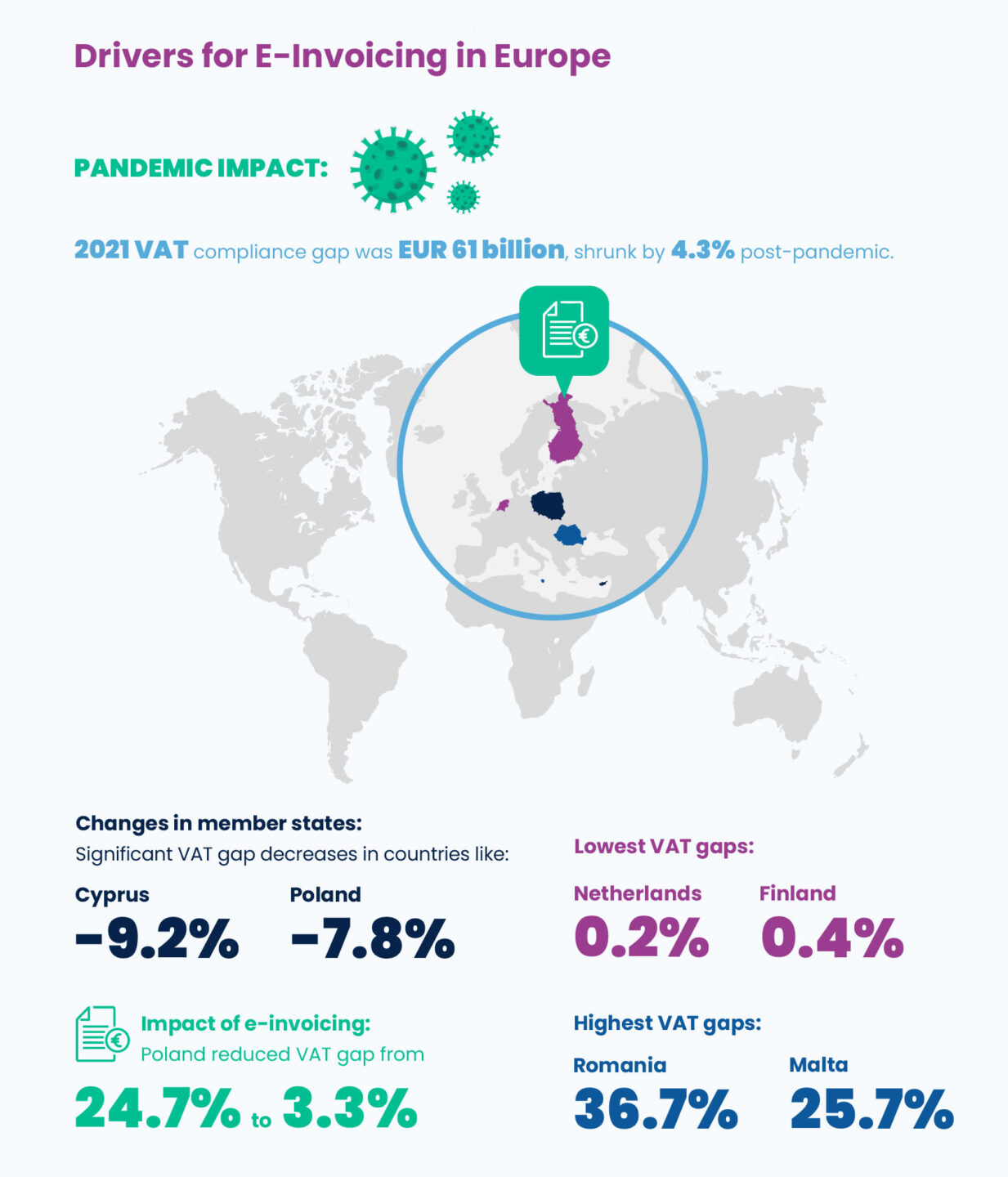
By 2030, all intra-EU B2B transactions will require structured e-invoices, creating a unified system for real-time digital reporting. This harmonisation effort is designed to reduce VAT fraud (the EU lost approximately EUR 61 billion in uncollected VAT in 2021 alone) and create a more efficient invoicing ecosystem across member states.
For organisations navigating these complex requirements, understanding the different models for continuous transaction controls is essential to selecting the right compliance architecture.
Top e-invoicing benefits to look for in 2026
With the regulatory landscape now firmly established, here are the compelling benefits of e-invoicing that organisations can realise in 2026 and beyond.
Significant cost savings and operational efficiency
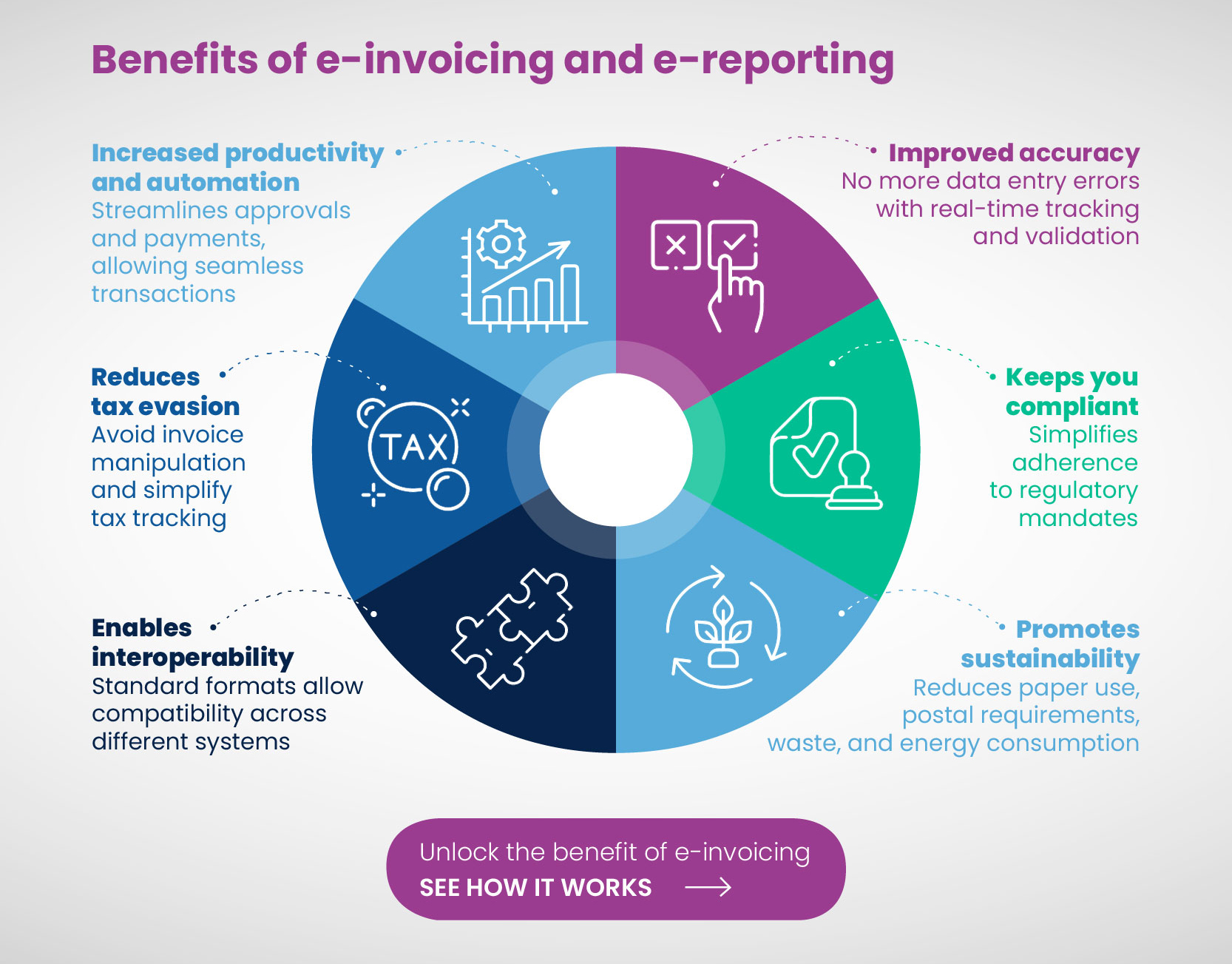
Cost reduction remains one of the most tangible e-invoicing benefits. Research consistently shows that organisations transitioning from paper-based to electronic invoicing can achieve cost savings of 60 to 80% on invoice processing. The average cost reduction associated with e-invoicing adoption is approximately 66% compared to traditional methods.
These savings stem from the elimination of printing, postage, manual data entry, and physical storage costs. For small firms in the UK alone, the estimated annual saving from e-invoicing adoption is GBP 11,300, with a return of 2.2 times the investment achievable over just two years.
When combined with broader data management strategies, the efficiency gains multiply further. Organisations that integrate e-invoicing in 2026 with automated archiving and reporting processes can streamline their entire financial workflow, freeing up resources for higher-value activities.
Faster payment cycles and improved cash flow
E-invoicing dramatically accelerates the invoice-to-payment cycle. Where traditional paper invoices can take days or even weeks to reach a recipient, structured electronic invoices are delivered instantly and can be processed automatically upon receipt.
Studies indicate that e-invoicing in 2026 can speed up payment cycles by up to 80%, reducing processing times from weeks to hours. This acceleration has a direct and positive impact on cash flow, which is particularly valuable for small and medium-sized enterprises that depend on timely payments to maintain operations.
Furthermore, the benefits of e-invoicing also contributes to reducing late payments by approximately 20%, creating more predictable revenue streams and enabling better financial planning across the organisation.
Enhanced accuracy and fewer errors
Manual invoice processing is inherently prone to errors, from data entry mistakes to mismatched purchase orders and incorrect tax calculations. One of the e-invoicing benefits addresses this challenge by automating validation processes and enforcing structured data formats.
The results are striking: e-invoicing reduces data entry errors by up to 90% through automated validation. Structured formats such as XML, UBL, and Factur-X ensure that invoice data is consistent, complete, and machine-readable, eliminating the ambiguity that often accompanies PDF or paper-based invoices.
Choosing the right e-invoicing format is a critical decision that directly influences the level of automation and accuracy an organisation can achieve. Fully structured formats deliver the greatest benefits in terms of straight-through processing and error reduction.
Stronger regulatory compliance and audit readiness
In a world where global tax compliance requirements are growing more complex by the year, e-invoicing in 2026 provides a robust foundation for meeting regulatory obligations. Electronic invoices create a complete, tamper-proof audit trail that simplifies both internal audits and external regulatory reviews.
E-invoicing systems automatically apply local tax rules, validate VAT identification numbers, and ensure that invoices comply with country-specific formatting requirements. This automation significantly reduces the risk of non-compliance and the associated financial penalties.
For organisations operating across multiple jurisdictions, such benefits of e-invoicing in 2026 is particularly valuable. Rather than manually tracking the evolving requirements in each country, businesses can rely on compliant e-invoicing platforms to handle the complexity. The growing burden of SAF-T and tax reporting requirements makes this automated approach increasingly essential.
Greater transparency and real-time visibility
E-invoicing transforms financial visibility by providing real-time tracking of invoice status throughout the entire lifecycle, from creation and delivery to approval and payment. This transparency enables finance teams to monitor outstanding invoices, identify bottlenecks, and make informed decisions based on up-to-date data.
Companies adopting e-invoicing in 2026 are experiencing a 60 to 70% reduction in reconciliation time thanks to real-time data flow between buyers and suppliers. This level of visibility was simply not possible with traditional invoicing methods.
Real-time visibility also supports better forecasting and working capital management. When finance leaders can see exactly where every invoice stands at any given moment, they can optimise payment timing, negotiate better terms with suppliers, and maintain tighter control over the organisation’s financial position.
Improved fraud prevention and security
Invoice fraud remains a significant threat to businesses worldwide, and the e-invoicing benefits provide powerful defences against it. Structured electronic invoices are far more difficult to forge or tamper with than paper or PDF invoices, particularly when combined with digital signatures and encrypted transmission channels.
Governments implementing e-invoicing in 2026 are increasingly requiring digital signatures and encrypted connections as standard security measures. The PEPPOL network, which underpins e-invoicing in many European countries, provides a trusted framework for secure invoice exchange between verified participants.
Environmental sustainability and ESG alignment
Possibly one of the most significant benefits of e-invoicing, the environmental case for electronic invoicing is compelling and increasingly relevant as organisations face growing pressure to demonstrate their ESG and sustainability commitments. Paper invoices produce approximately three times more CO2 than their electronic counterparts, and switching to e-invoicing can cut the carbon footprint of the invoice lifecycle by up to 63%.
Consider the scale of the opportunity: approximately 560 billion invoices are issued globally each year, with around 435 billion still in paper format. These paper invoices generate an estimated 52 megatonnes of CO2 annually. In Europe alone, 30 billion invoices sent each year consume around 12 million trees.
Fully structured e-invoices are also 30 to 50% smaller in file size compared to PDFs, reducing the processing power and energy required for storage and transmission. For organisations reporting on sustainability metrics, the transition to e-invoicing in 2026 provides a measurable and meaningful contribution to their environmental goals.
Stronger supplier and customer relationships
E-invoicing benefits also foster better business relationships by removing many of the friction points that characterise traditional invoicing. Faster invoice delivery, quicker approvals, and more predictable payment timelines all contribute to stronger trust between trading partners.
When suppliers receive payments faster and more reliably, they are more likely to offer favourable terms, prioritise orders, and invest in the relationship. Buyers, in turn, benefit from fewer disputes (thanks to improved accuracy) and greater confidence in their accounts payable processes.
The standardised data exchange that e-invoicing enables also simplifies onboarding new trading partners. Rather than negotiating bespoke invoicing formats and processes, both parties can rely on established standards, reducing the time and cost associated with establishing new business relationships.
Scalable and future-ready digital infrastructure
Adopting e-invoicing in 2026 is not merely about meeting today’s compliance requirements; it is about building a digital foundation that can adapt to tomorrow’s demands. Cloud-based e-invoicing solutions offer scalability, accessibility, and cost efficiency that on-premise systems cannot match.
As regulations continue to evolve and new mandates emerge, organisations with modern e-invoicing infrastructure can adapt quickly without significant re-engineering. This agility is particularly important given the pace at which new requirements are being introduced globally.
The significant benefits of e-invoicing also serve as a gateway to broader digital transformation. The structured data generated by electronic invoices can feed into analytics platforms, support AI-driven insights, and integrate with SAP S/4HANA and other modern ERP systems to create a truly connected financial ecosystem.
How SAP DRC supports e-invoicing compliance
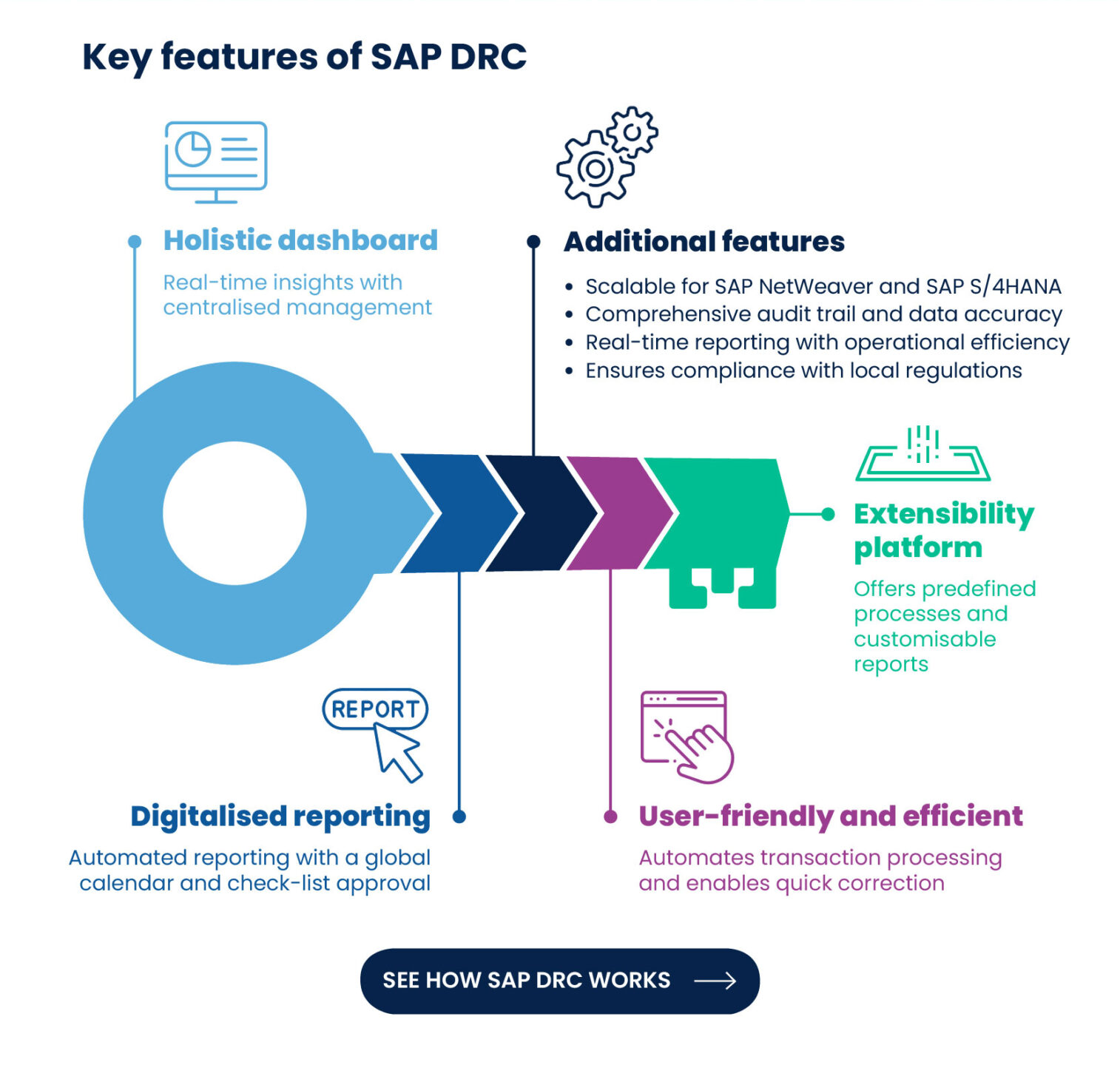
For organisations running SAP, SAP Document and Reporting Compliance (SAP DRC) provides a comprehensive solution for managing e-invoicing and e-reporting requirements. The solution enables organisations to create, process, and monitor transactional documentation and periodic reporting, ensuring compliance with local legal frameworks across multiple jurisdictions.
SAP DRC comes equipped with several standout components that make it particularly effective for compliance of e-invoicing in 2026:
- Compliance calendar: Users can proactively monitor global e-invoicing and reporting regulations, staying ahead of upcoming deadlines and requirement changes.
- Automated submission: The solution automates the submission of e-invoices, providing data-backed insights on transactions and reducing the manual effort required for compliance.
- Centralised management: A centralised point of entry manages corrections and ensures timely follow-ups, streamlining the entire compliance workflow.
- Integration and scalability: SAP DRC integrates seamlessly with SAP S/4HANA, making it an ideal companion for organisations undergoing digital transformation.
Conclusion
E-invoicing in 2026 is far more than a compliance obligation; it is a strategic opportunity to reduce costs, eliminate errors, and future-proof financial operations. With over 60 countries enforcing mandates and measurable benefits ranging from 66% cost reductions to 80% faster payment cycles, the case for early adoption is clear.
Technologies such as SAP DRC, AI-powered automation, and the PEPPOL network make multi-jurisdictional compliance manageable from a single platform, while the growing shift towards continuous transaction controls means that organisations acting now will avoid costly retrofitting later; moreover, enjoying the benefits of e-invoicing from the start.
TJC Group’s extensive expertise in SAP compliance and data management ensures your transition is smooth, compliant, and value-driven. Our B2G team works closely with you to ensure your requirements and expectation of e-invoicing benefits are met while following the best practices for SAP DRC implementation. Contact us today to turn e-invoicing compliance into a genuine strategic advantage.
Q1. Why is e-invoicing becoming essential in 2026?
Answer:
E-invoicing is becoming essential because many countries are introducing or expanding mandatory e-invoicing and digital reporting requirements. For organisations operating across borders, this makes compliance more complex, but also creates an opportunity to improve efficiency, reduce costs and standardise invoice processing.
Q2. What are the main benefits of e-invoicing for businesses?
Answer:
The main benefits include lower invoice processing costs, faster payment cycles, fewer manual errors, stronger audit readiness, better visibility over invoice status, improved fraud prevention and a reduced environmental footprint.
Q3. What is SAP Document and Reporting Compliance (SAP DRC)?
Answer:
SAP Document and Reporting Compliance, commonly known as SAP DRC, is an SAP solution that helps organisations manage e-invoicing and e-reporting requirements across different countries. It supports the creation, processing, monitoring and submission of legally required documents and reports, helping businesses stay compliant with local tax regulations.
Q4. How does e-invoicing improve tax compliance?
Answer:
E-invoicing supports tax compliance by using structured, machine-readable formats that can be validated automatically. It also helps create a reliable audit trail, apply local tax rules, check VAT information and meet country-specific formatting and reporting requirements.
Q5. How can SAP users manage e-invoicing requirements?
Answer:
Organisations running SAP can use SAP Document and Reporting Compliance to manage e-invoicing and e-reporting requirements across multiple jurisdictions. It supports automated submissions, compliance monitoring, centralised corrections and integration with SAP S/4HANA.