



Author: Patchanok Kluabkaew, B2G Team Lead
With pilot programmes beginning in July 2026 and mandatory adoption rolling out from 2027, e-invoicing in the UAE is getting a head start in the world of electronic invoicing. With that in mind, organisations operating in the UAE must start preparing now to ensure compliance and minimise disruption. Read this blog for the latest updates.
Table of contents
Introduction
The United Arab Emirates is taking a major step towards digital tax transformation through the introduction of its national e-invoicing framework. As part of the country’s broader digital economy strategy, the UAE Ministry of Finance (MoF) is implementing a phased e-invoicing mandate that will fundamentally change how businesses create, exchange, and report invoices.
The UAE’s e-invoicing model aims to improve tax compliance, reduce fraud, enhance business efficiency, and support real-time digital reporting across the economy.
E-invoicing in the UAE: The framework
The UAE has adopted a Decentralised Continuous Transaction Control and Exchange (DCTCE) model based on the PEPPOL framework. Under this model, businesses exchange invoices through accredited service providers rather than directly through a central government platform. The UAE’s e-invoicing framework uses the PINT AE (Peppol International Invoice UAE) data standard to ensure interoperability and consistency.
A typical transaction flow involves:
- A supplier generating an e-invoice.
- The invoice being transmitted through an Accredited Service Provider (ASP).
- Validation against UAE e-invoicing standards.
- Delivery to the buyer.
- Reporting to the relevant tax authorities where required.
This approach enables seamless invoice exchange while maintaining compliance with UAE tax regulations.
Latest developments in the UAE e-invoicing framework
Pilot phase begins in July 2026
One of the most significant recent announcements is the launch of the pilot programme from 1 July 2026 for e-invoicing in the UAE. Selected businesses participating in the Taxpayer Working Group, along with voluntary adopters, will be able to test the system before mandatory implementation begins.
The pilot phase is designed to:
- Validate technical integrations.
- Test invoice exchange mechanisms.
- Identify compliance gaps.
- Improve readiness across the business ecosystem.
Finalisation of PINT AE specifications
The Ministry of Finance has finalised the PINT AE data standards, providing detailed guidance on invoice structures, mandatory fields, validation rules, and technical requirements. These specifications form the foundation of the e-invoicing framework and compliance, while being implemented by accredited service providers.
Read more: E-invoicing in Spain: What you need to know
Accreditation of service providers
The UAE has also established a framework for accrediting service providers of electronic invoicing. The Ministry of Finance maintains a list of pre-approved providers that will facilitate invoice transmission, validation, and compliance reporting for businesses.
Timeline update for large businesses
In May 2026, the Ministry of Finance extended the deadline for large businesses with annual revenues exceeding AED 50 million to appoint an Accredited Service Provider (ASP). The deadline was moved from 31 July 2026 to 30 October 2026, providing organisations with additional preparation time for e-invoicing in the UAE.
UAE e-invoicing implementation timeline
The UAE has adopted a phased implementation approach:
| Phase | Organisation type | Key date |
| Pilot and voluntary adoption | Selected taxpayers and voluntary participants | 1 July 2026 |
| Phase 1 | Businesses with annual revenue ≥ AED 50 million | Mandatory from 1 January 2027 |
| Phase 2 | Businesses with annual revenue < AED 50 million | Mandatory from 1 July 2027 |
| Phase 3 | Government entities (B2G transactions) | Mandatory from 1 October 2027 |
Large businesses must appoint an Accredited Service Provider by 30 October 2026, while smaller businesses and government entities have later compliance deadlines.
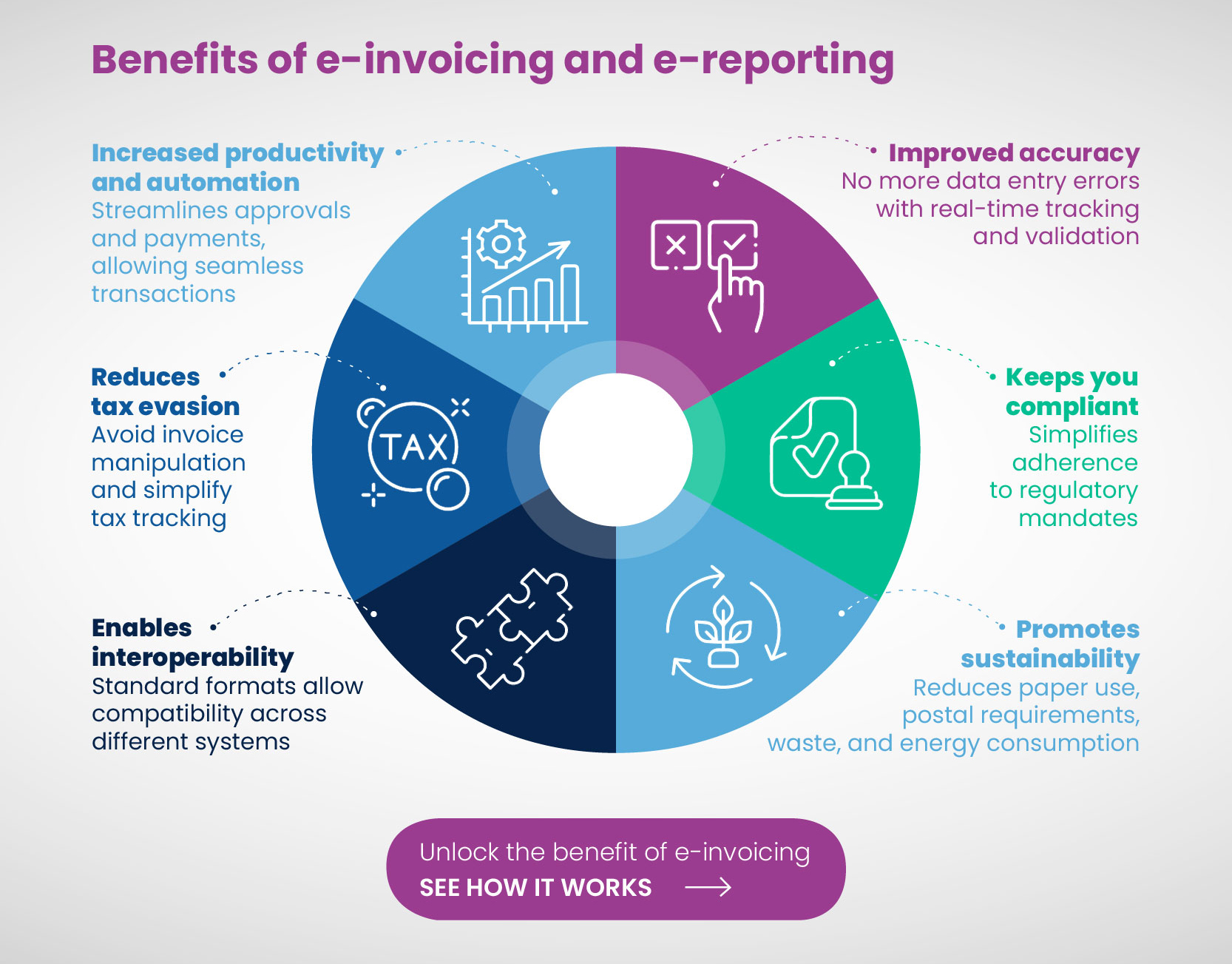
Benefits of e-invoicing for UAE businesses
While compliance is a key driver, the UAE’s e-invoicing framework also delivers several operational advantages:
- Improved efficiency: Automation reduces manual data entry, invoice processing times, and administrative workloads.
- Enhanced accuracy: Structured invoice data minimises human error and improves financial reporting quality.
- Faster payments: The e-invoicing framework enables quicker invoice approvals and shorter payment cycles.
- Better compliance: Standardised invoice validation helps businesses meet VAT and regulatory requirements more effectively.
- Increased visibility: Real-time invoice tracking improves cash flow management and financial transparency.
The UAE is part of a growing global movement towards e-invoicing, with countries across the world mandating electronic invoicing to improve tax compliance and operational efficiency.
How businesses can prepare for e-invoicing in the UAE
With the implementation timeline now firmly established, organisations should begin preparing immediately.
Key preparation steps include:
- Assessing ERP and accounting system readiness.
- Mapping existing invoice data to PINT AE requirements.
- Reviewing supplier and customer onboarding processes.
- Selecting an Accredited Service Provider.
- Testing integrations ahead of mandatory deadlines.
- Training finance, tax, and IT teams on new compliance requirements.
Early preparation for e-invoicing will reduce implementation risks and allow businesses to take advantage of voluntary adoption opportunities before enforcement begins.
Looking ahead
The initiative for e-invoicing in the UAE represents one of the most significant tax technology transformations in the region. By adopting a PEPPOL-based decentralised e-invoicing framework and implementing phased compliance requirements, the government is creating a modern digital invoicing ecosystem that aligns with international best practices.
As July 2026 marks the beginning of the pilot phase, businesses that act now will be best positioned to achieve compliance, streamline operations, and benefit from the efficiencies that e-invoicing can deliver. For any further information on the UAE’s e-invoicing updates, requirements, and more, stay tuned with TJC Group blogs.
Q1. What e-invoicing model has the UAE adopted?
Answer:
The UAE has adopted a Decentralised Continuous Transaction Control and Exchange (DCTCE) model based on the PEPPOL framework. Under this model, businesses exchange invoices through Accredited Service Providers (ASPs) rather than directly through a central government platform, using the PINT AE (Peppol International Invoice UAE) data standard.
Q2. When does e-invoicing become mandatory in the UAE?
Answer:
E-invoicing in the UAE follows a phased rollout. The pilot programme begins on 1 July 2026. Mandatory compliance starts on 1 January 2027 for businesses with annual revenue of AED 50 million or more, followed by smaller businesses from 1 July 2027 and government entities (B2G transactions) from 1 October 2027.
Q3. What is the deadline for appointing an Accredited Service Provider (ASP)?
Answer:
Large businesses with annual revenues exceeding AED 50 million must appoint an ASP by 30 October 2026 (extended from the original deadline of 31 July 2026). Smaller businesses and government entities have later deadlines, with ASP appointments required by 31 March 2027.
Q4. How can businesses prepare for e-invoicing in the UAE?
Answer:
Businesses should start by assessing their ERP and accounting system readiness, mapping existing invoice data to the PINT AE specifications, selecting an Accredited Service Provider, and training their finance, tax, and IT teams on the new compliance requirements. Early preparation, including participation in the voluntary pilot phase, will help reduce implementation risks.