




Author: Audren Butery, SAP Consultant at TJC Group
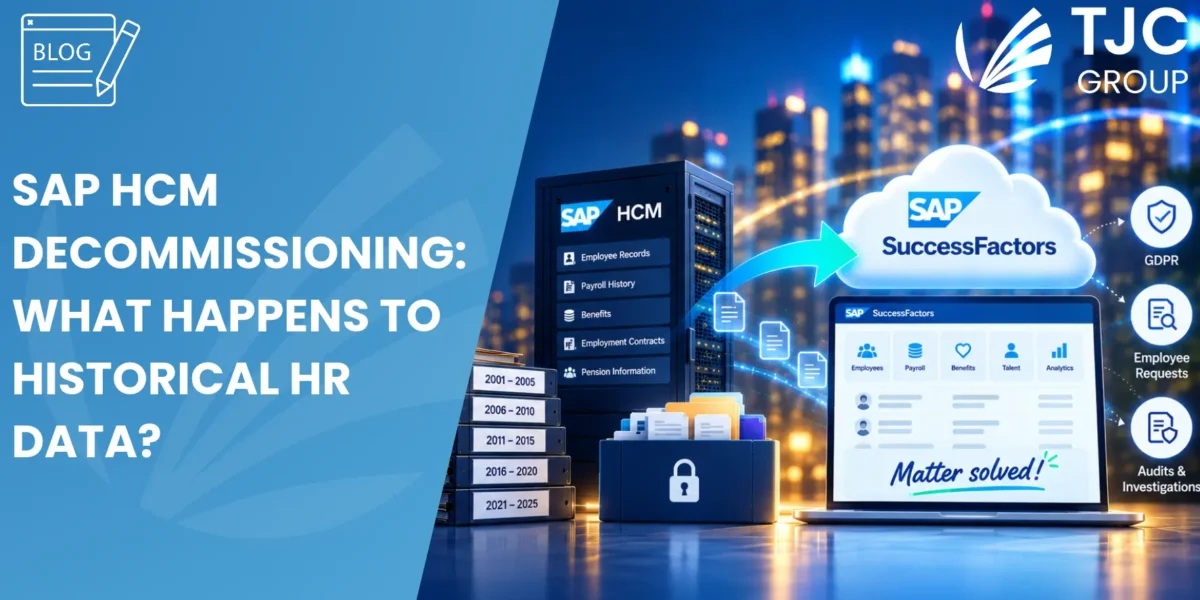
Moving to SAP SuccessFactors raises an important question: what happens to decades of employee, payroll, pension and benefits records left behind in SAP HCM? Not every record needs to move to the cloud, but organisations must still meet retention, privacy, and audit requirements. This article explores the challenges of SAP HCM decommissioning and how to preserve historical HR data without keeping ageing systems running.
Table of contents
- Introduction
- What happens when an organisation moves to SuccessFactors?
- Why does historical data still matter to HR managers?
- Example: Protecting historical payroll records after SAP HCM decommissioning
- Three options for managing legacy SAP HCM data
- Why SAP HCM decommissioning requires special consideration
- 2) Extracting HR data in a usable format
- Why a user-friendly decommissioning platform matters for HR teams
- How ELSA supports historical HR data access after SAP HCM decommissioning
- A real-world case of SAP decommissioning
- Planning for historical HR data beyond SuccessFactors migration
Introduction
Moving from SAP HCM to SAP SuccessFactors is a major change for any HR department. The new cloud environment supports day-to-day workforce processes, but what happens to the years of employee information held in the old system?
An SAP HCM environment may contain decades of payroll records, employment contracts, pension details and information about former employees. Not all of this needs to be transferred to SuccessFactors, but some records may still be required for audits, employee requests, or regulatory purposes.
This leaves HR departments with an important decision: how to retire their legacy SAP HCM system without losing access to historical HR data?
What happens when an organisation moves to SuccessFactors?
Imagine a company that has used SAP ECC HCM for 25 years. Its system contains employee information going back to 2001, including payroll history, employment contracts, benefits, pension information and records of employees who retired years ago.
In 2026, the company decides to move its HR operations to SAP SuccessFactors. Does it really need to migrate all 25 years of HR history into the new cloud environment?
Not necessarily.
The company may migrate active employee information and selected historical records needed for ongoing HR operations. However, much of the older information may no longer serve a day-to-day purpose.
That does not mean it can simply be discarded.
Why does historical data still matter to HR managers?
An employee may leave an organisation, but the need to access their records does not always end with their employment.
Consider a few situations:
- A retired employee requests information about pension entitlements years after leaving.
- A former employee challenges an employment decision, requiring the organisation to produce supporting records.
- An auditor requests payroll information from an earlier financial year.
- HR needs to verify previous employment or benefits information.
- Certain employment records must remain available to meet applicable legal or regulatory obligations.
Some records may need to be retained for extended periods to meet compliance requirements, while others should be removed once there is no longer a lawful basis for keeping them.
Example: Protecting historical payroll records after SAP HCM decommissioning
Consider an organisation that migrated from SAP HCM to SuccessFactors several years ago. A former employee raises a dispute, claiming they were not paid certain benefits or that their final salary was calculated incorrectly.
To respond, the HR team needs access to historical payroll records, salary adjustments and supporting employment information. However, these records may be stored across different structures in the legacy SAP HCM system, making a simple database export insufficient.
This is where SAP HCM decommissioning, supported by a reliable historical data preservation strategy, becomes important. Rather than keeping the entire legacy system running, organisations can preserve relevant payroll records with their original business context and make them accessible to authorised HR teams.
This helps the organisation investigate claims, verify past payments, and respond to employment disputes using reliable historical evidence.
At the same time, organisations cannot overlook GDPR requirements. Historical payroll information contains sensitive personal details that should not remain accessible to everyone indefinitely. HR leaders must apply appropriate access restrictions, establish lawful retention periods or anonymise personal information when it is no longer required and no other lawful basis for retention applies.
By combining secure access to historical data with appropriate retention controls, organisations can protect both employee rights and their own interests, even after the original SAP HCM system has been retired.

Three options for managing legacy SAP HCM data
Once SuccessFactors becomes the primary HR platform, organisations generally have three approaches to managing the information left in SAP HCM.

Option 1: Migrate all historical data to SuccessFactors
One approach is to move the entire HR history into the new environment.
However, historical SAP HCM records may need to be transformed to fit the data structures of SuccessFactors. Not every legacy field or data relationship has a direct equivalent in the new platform.
This introduces concerns around data traceability.
When records are transformed during migration, demonstrating their relationship to the original information can become more difficult. If an auditor or another authorised party requests evidence from the source system, the organisation may need to establish that the information remains complete and accurate.
Migrating everything can also increase project complexity and bring records into the new environment that are not required for ongoing HR operations.
Option 2: Keep SAP ECC HCM running for historical access
Another approach is to retain the old SAP HCM environment, often in read-only mode, so that HR teams can retrieve records when necessary.
This avoids an immediate decision about where to preserve historical information, but keeping the system available brings its own challenges.
Hidden costs: Even when an old system runs on a virtual machine, it still requires infrastructure, maintenance, software support, and people to manage it. These expenses are not always visible when organisations calculate the cost of retaining the system.
Declining knowledge: As experienced employees retire or move to other roles, the organisation gradually loses the technical and functional knowledge needed to operate the legacy application.
Cybersecurity risks: Older operating systems, databases and software components may fall out of vendor support. Maintaining appropriate security becomes harder, especially when the environment contains sensitive employee information.
Outdated infrastructure: Over time, compatibility issues can make the system increasingly difficult to maintain, even if it is only used occasionally.
Keeping SAP HCM running may be feasible, but it means continuing to support an entire application primarily to retrieve historical records.
Option 3: Preserve historical HR data and decommission SAP HCM
An effective approach is to extract the complete historical dataset into a single storage environment. This allows organisations to retire the original SAP HCM environment without losing access to important records.
A key advantage of this approach is that organisations don’t need to decide upfront which individual records they might need years later. By preserving the complete dataset and its original business context, they can reduce the risk of overlooking information that may become relevant during future audits, pension enquiries, or employment disputes.
However, preserving historical information is only part of the solution. The data must also remain accessible and manageable. A centralised, intuitive platform lets authorised HR teams search, view, and retrieve historical records without relying on the original SAP application or specialist technical knowledge. Through this approach, organisations can also continue managing GDPR requirements after decommissioning. For example, TJC Group’s ELSA provides data privacy features that allow organisations to implement their GDPR strategy within the preserved historical data environment.
Appropriate access controls and retention policies remain essential to protecting sensitive employee information throughout its lifecycle.
In this way, organisations can retire ageing SAP HCM infrastructure while maintaining secure, controlled access to historical HR data. However, achieving this requires careful consideration of the technical complexities and privacy requirements associated with employee information, which we explore in the following sections.
Why SAP HCM decommissioning requires special consideration
HR data presents two important challenges during legacy system retirement: the sensitivity of employee information and the technical complexity of extracting it.
1) Protection of sensitive employee information
An SAP HCM system may contain salaries, bank account details, national identification numbers, employment disputes, disciplinary records, and information about dependents.
Not everyone who needs access to historical HR records should be able to see all of this information.
For example, an HR manager reviewing a former employee’s employment history may not need access to unrelated banking or identification details.
This makes authorisation controls, data masking and retention management important considerations when selecting a historical data access solution.
Organisations also need to account for applicable privacy requirements, including the GDPR, when determining how personal information is retained, accessed, anonymised or deleted.
2) Extracting HR data in a usable format
Technical challenges are equally important.
In SAP HCM environments, some HR information may be stored in clustered or encrypted tables. Extracting these records requires an understanding of how the underlying data is structured and interpreted.
A straightforward database export may produce information that is difficult to read or lacks the expected business context.
Specialist extraction knowledge and appropriate tools are therefore needed to retrieve the information in a usable format while preserving its integrity and traceability.
These considerations become particularly important when the original SAP system is no longer available to help interpret the records.
Why a user-friendly decommissioning platform matters for HR teams
Preserving historical HR data is only one part of the challenge. The information must also remain accessible to the people who need it, even years after SAP HCM has been retired.
By then, the employees familiar with the original system may have moved on. HR managers should not need to understand SAP transaction codes, table structures or payroll clusters to retrieve historical records. If accessing a single document requires an IT ticket and specialist support, the organisation has simply replaced one dependency with another.
An effective decommissioning platform should make historical information easy to find and retrieve. In practice, that means:
- Searching by familiar criteria such as employee name, personnel number or date range
- Viewing records with their original business context so payroll results and employment history remain meaningful
- Restricting access according to user roles and responsibilities
- Supporting retention, anonymisation and deletion requirements within the preserved environment
When historical information is easy to retrieve, it remains useful to HR teams long after the original SAP HCM system has been retired.
How ELSA supports historical HR data access after SAP HCM decommissioning
TJC Group’s Enterprise Legacy System Application (ELSA) enables organisations to access and manage historical SAP data after the original system has been decommissioned.
Once the complete historical dataset has been extracted and securely preserved, organisations can decide which information needs to be readily accessible for ongoing business requirements.
For example, a company with 25 years of historical HR records may only need the most recent five years available for regular access, while keeping the complete dataset preserved in storage.
Depending on its requirements, selected information can be loaded into ELSA for authorised users to retrieve when needed.
Retention, anonymisation and other GDPR-related controls can then be applied within ELSA, helping organisations manage historical information without unnecessarily increasing the cost and complexity of decommissioning.
1) Preserving data integrity and traceability
ELSA’s extraction approach is designed to preserve information from the original SAP system while maintaining data completeness, integrity, and traceability.
This helps organisations retain a reliable record of historical information that may need to be verified years after the system has been decommissioned.
For HR departments, this is particularly relevant when retrieving earlier payroll records, employment information, or other documentation required for authorised reviews.
2) Controlling access to sensitive HR records
ELSA supports field masking and role-based access controls to help organisations manage who can view historical information.
Sensitive fields can be fully or partially concealed. For example, a bank account number may be displayed with only its final four digits visible.
Access can also be restricted according to defined authorisations, such as specific personnel numbers or company codes.
This allows HR teams to retrieve the information relevant to their responsibilities without providing unrestricted access to the wider historical dataset.
3) Managing retention, anonymisation and deletion
Historical HR information cannot always be retained indefinitely.
ELSA supports configurable deletion and anonymisation capabilities that can be applied to selected records or fields according to defined requirements.
For example, an organisation may identify a set of employee records eligible for anonymisation and apply the appropriate rule to the relevant information.
Separately, it supports exporting personal information to help organisations respond to applicable employee data access requests.
These capabilities allow organisations to manage historical information over time, rather than treating preservation as a permanent obligation to keep every record.
4) Bringing multiple legacy sources together
ELSA brings historical information from multiple legacy sources into a central platform, reducing the need to maintain separate systems solely for occasional data retrieval. This makes historical HR information available to the people who need it while allowing organisations to move away from ageing infrastructure.
A real-world case of SAP decommissioning
TJC Group case study: Saving $250K annually through SAP legacy decommissioning
A global manufacturer needed to retire its legacy SAP ECC environment four years after migrating to SAP S/4HANA. The challenge was to reduce the cost of maintaining the legacy SAP landscape while preserving historical business data that hadn’t been migrated.
TJC Group supported the decommissioning project using its Audit Extraction Cockpit (AEC) and Enterprise Legacy System Application (ELSA).
Historical SAP data was securely extracted and preserved, including records from divested entities and critical employee information for retired pensioners. ELSA enabled continued access to the necessary information without maintaining the original SAP environment.
The project delivered $250,000 in annual software licensing and maintenance savings, equivalent to approximately $1 million over four years, while enabling the retirement of the legacy SAP landscape.

Although this project was part of a broader SAP ECC decommissioning initiative, it shows how organisations can preserve the complete historical dataset, including payroll records and their original business context.

Planning for historical HR data beyond SuccessFactors migration
Moving to SAP SuccessFactors is an opportunity to modernise HR operations, but it also raises important questions about the historical information left behind. Payroll records, pension details and employment histories may still be needed long after the original SAP HCM system has been retired.
The challenge is to preserve this information without maintaining an ageing application solely for occasional access. A well-planned SAP HCM decommissioning strategy can help organisations achieve this while maintaining appropriate security, privacy and retention controls.
By combining reliable historical data preservation with intuitive, centralised access, organisations can retire legacy infrastructure while ensuring that authorised HR teams can continue to retrieve the information they need.
Key notes for HR leaders and decision-makers
- Involve HR early: Ensure historical data requirements are considered before retiring the legacy system.
- Think beyond active employees: Account for records relating to former employees, retirees and pension beneficiaries.
- Define access rights: Ensure sensitive employee information is accessible only to authorised users.
- Test data retrieval: Verify that payroll, pension and employment records remain accessible and understandable after extraction.
- Establish data ownership: Assign responsibility for retention policies, access requests and ongoing privacy compliance.
Frequently Asked Questions
Q1. What happens to historical HR data after SAP SuccessFactors migration?
Answer:
After SAP SuccessFactors migration, organisations typically transfer employee information required for ongoing HR operations. However, historical payroll, pension, benefits and employment records may still be needed for audits, employee enquiries or legal obligations. These records can be preserved separately, allowing organisations to retain access without migrating decades of historical information into SuccessFactors.
Q2. Can SAP HCM be decommissioned without losing access to historical employee records?
Answer:
Yes. One effective approach to SAP HCM decommissioning is to extract the complete historical dataset in a single operation and preserve it in an independent repository. Once the information has been validated and made accessible to authorised users, the legacy system can be retired while maintaining appropriate retention, security and privacy controls.
Q3. How long should historical SAP HCM data be retained?
Answer:
SAP HCM data retention periods depend on the type of employee information, applicable regulations and business requirements. Payroll, pension and employment records may have different retention obligations. Organisations should establish appropriate retention policies and ensure that personal information is anonymised or deleted when there is no longer a lawful basis for retaining it.
Q4. Why is extracting historical payroll data from SAP HCM technically challenging?
Answer:
Historical SAP HCM payroll information may be stored in complex data structures, including clustered tables. A simple database export may not preserve the relationships and business context needed to interpret these records correctly. Specialist extraction methods help maintain data integrity and traceability, ensuring historical payroll information remains usable after SAP HCM decommissioning.
Q5. How can HR teams access historical employee records after SAP HCM decommissioning?
Answer:
Historical employee records can be accessed through a centralised legacy data access platform without relying on the original SAP HCM system. Authorised HR teams can search for payroll, pension and employment information using familiar criteria, such as employee names or personnel numbers. Role-based access controls and appropriate privacy measures help protect sensitive information while keeping necessary records accessible.


