



Author: Priyasha Purkayastha, Global Content Manager, TJC Group
As SAP ECC approaches its end-of-maintenance deadline, organisations worldwide are accelerating their S/4HANA migration plans. Yet one critical step is frequently underestimated: decommissioning legacy systems. Far from being an afterthought, legacy system decommissioning is a strategic imperative that directly determines the cost, speed, and long-term success of your S/4HANA transformation.
Table of contents
Introduction
The clock is ticking for organisations still running SAP ECC; with SAP ending mainstream maintenance by 2027, the pressure to migrate to SAP S/4HANA has never been greater. However, rushing into migration without addressing legacy systems is a costly mistake that many organisations make.
Decommissioning legacy systems involves safely extracting historical data from outdated SAP and non-SAP environments, preserving it in an accessible format, and then shutting down those systems permanently. This process is not merely about switching off old servers; it is about creating a leaner, more secure, and more compliant IT landscape that sets the foundation for a successful S/4HANA migration.
In this article, we explore the compelling reasons why decommissioning legacy systems for S/4HANA is not optional but necessary, and how a structured approach can save your organisation significant time, money, and risk.
What is legacy system decommissioning?
Legacy system decommissioning is the process of retiring outdated IT systems while ensuring that all essential historical data remains accessible and compliant. Rather than simply pulling the plug, a proper decommissioning project follows a structured methodology that includes assessment, data extraction, validation, and finally, system shutdown.
The journey from sunsetting to decommissioning typically involves extracting 100% of legacy data into a centralised, secure repository. This repository can be cloud-based, on-premises, or hybrid, depending on the organisation’s requirements.
Once extracted, the data is made available through a dedicated application that allows business users to search, retrieve, and report on historical information without needing access to the original legacy system. This approach eliminates the ongoing costs and risks of maintaining outdated infrastructure whilst preserving full access to critical business data.
Why decommissioning is essential before S/4HANA migration
There are several strategic reasons why organisations must prioritise legacy system decommissioning in S/4HANA migration. Let us examine each in detail.
Reducing total cost of ownership
Perhaps the most immediate and tangible benefit of decommissioning is the dramatic reduction in operating costs. Legacy systems are expensive to maintain licensing fees, infrastructure costs, storage, runtime environments, operating systems, and specialist personnel all contribute to a significant ongoing financial burden.
Research indicates that complete decommissioning of old systems can achieve savings of 60 to 80 per cent in operating costs. In one documented case, a global manufacturing company saved over $250,000 annually by decommissioning its legacy SAP ECC system before moving to S/4HANA. The hidden costs of legacy systems extend far beyond obvious line items, finding experts who understand how to manage ageing legacy software becomes increasingly difficult and expensive as systems age.
Furthermore, because S/4HANA runs on an in-memory database, every unnecessary gigabyte of data that migrates to the new system increases HANA licensing and infrastructure costs. Decommissioning ensures that only relevant, actively used data makes the journey to your new environment.
Minimising S/4HANA migration complexity
The volume of data accumulated over years, sometimes decades, in traditional SAP systems can represent a major obstacle to a smooth migration. On average, only around 20% of existing data actually needs to be transferred to the new S/4HANA system. Migrating everything is not only unnecessary but counterproductive.
By decommissioning legacy systems and archiving historical data beforehand, organisations can reduce the volume of data to migrate by 30 to 70 per cent. This directly translates into shorter migration timelines, reduced downtime, and lower project costs. Understanding the importance of SAP data archiving when migrating to S/4HANA is essential for any organisation planning this transition.
The differences between SAP S/4HANA and SAP ECC include a fundamentally simplified data model, which means that data must be transformed during migration. Less data to transform means fewer risks and complications.
Strengthening cybersecurity posture
Unpatched legacy systems represent one of the biggest cybersecurity threats facing organisations today. According to the SAPinsider Cybersecurity Report, unpatched systems are among the most significant challenges organisations face in securing their SAP environments.
Once SAP ends maintenance for ECC, security patches will no longer be provided, leaving these systems increasingly vulnerable to cyberattacks. Decommissioning legacy systems is a strategic imperative for better cybersecurity, as it eliminates these vulnerable entry points from your IT landscape entirely.
Leaving legacy systems running in a “do nothing” state may seem harmless, but it creates an expanding attack surface that cybercriminals can exploit. The only way to fully eliminate this risk is to extract the data and shut down the system.
Ensuring regulatory and tax compliance
Organisations are legally required to retain historical data for tax, audit, and regulatory purposes, often for periods of seven to ten years or more. However, keeping legacy systems running solely to satisfy these requirements is an expensive and risky approach.
Decommissioning provides a far more effective solution: data is extracted into a compliant repository where it remains fully accessible for audits and regulatory enquiries. This approach ensures compliance with GDPR and data privacy regulations, which legacy systems are often ill-equipped to handle.
Modern data privacy laws require organisations to manage, locate, and potentially delete personal data upon request. Legacy systems frequently lack the capabilities to support these requirements, exposing organisations to substantial financial penalties and legal action.
Improving data quality and system performance
S/4HANA migration offers a unique opportunity to cleanse and improve your data landscape. Carrying years of inconsistent, duplicate, or obsolete data into a new system undermines the benefits of S/4HANA and its advanced analytical capabilities.
By decommissioning legacy systems and implementing SAP data archiving strategies before migration, organisations can ensure that only high-quality, relevant data enters the new environment. This results in better system performance, more accurate reporting, and a stronger return on your S/4HANA investment.
Keeping HANA database growth under control from the very start is far more effective than attempting to address data volume issues after migration.
Supporting a clean core strategy
SAP’s clean core philosophy encourages organisations to maintain a streamlined, standard S/4HANA environment free from excessive customisations and unnecessary data. Decommissioning legacy systems is a foundational element of this strategy.
A clean core approach ensures that your new S/4HANA system optimises for performance, making it easier to upgrade in the future. By removing historical data from the migration scope and preserving it separately, organisations can fully embrace this philosophy without losing access to critical business information.
Enabling environmental sustainability
An often-overlooked benefit of decommissioning is its positive environmental impact. Running legacy systems consumes significant energy for servers, cooling, and storage infrastructure. By shutting down these systems, organisations can meaningfully reduce their energy consumption and carbon footprint, contributing to corporate sustainability goals and net-zero targets.
The S/4HANA migration approaches and where decommissioning fits
When planning an S/4HANA migration, organisations typically choose from three main approaches: greenfield (new implementation), brownfield (system conversion), or Selective Data Transition (SDT). Each has different implications for legacy data management.
In a greenfield approach, the organisation starts fresh with a new S/4HANA implementation. This creates an immediate need to decommission the old ECC system, as historical data will not carry over automatically. Understanding what happens to legacy SAP systems on the path to S/4HANA is critical in this scenario.
A brownfield approach converts the existing system, carrying all data forward. Whilst this preserves continuity, it also migrates unnecessary historical data, increasing costs and complexity. SAP data archiving before a brownfield migration is therefore essential.
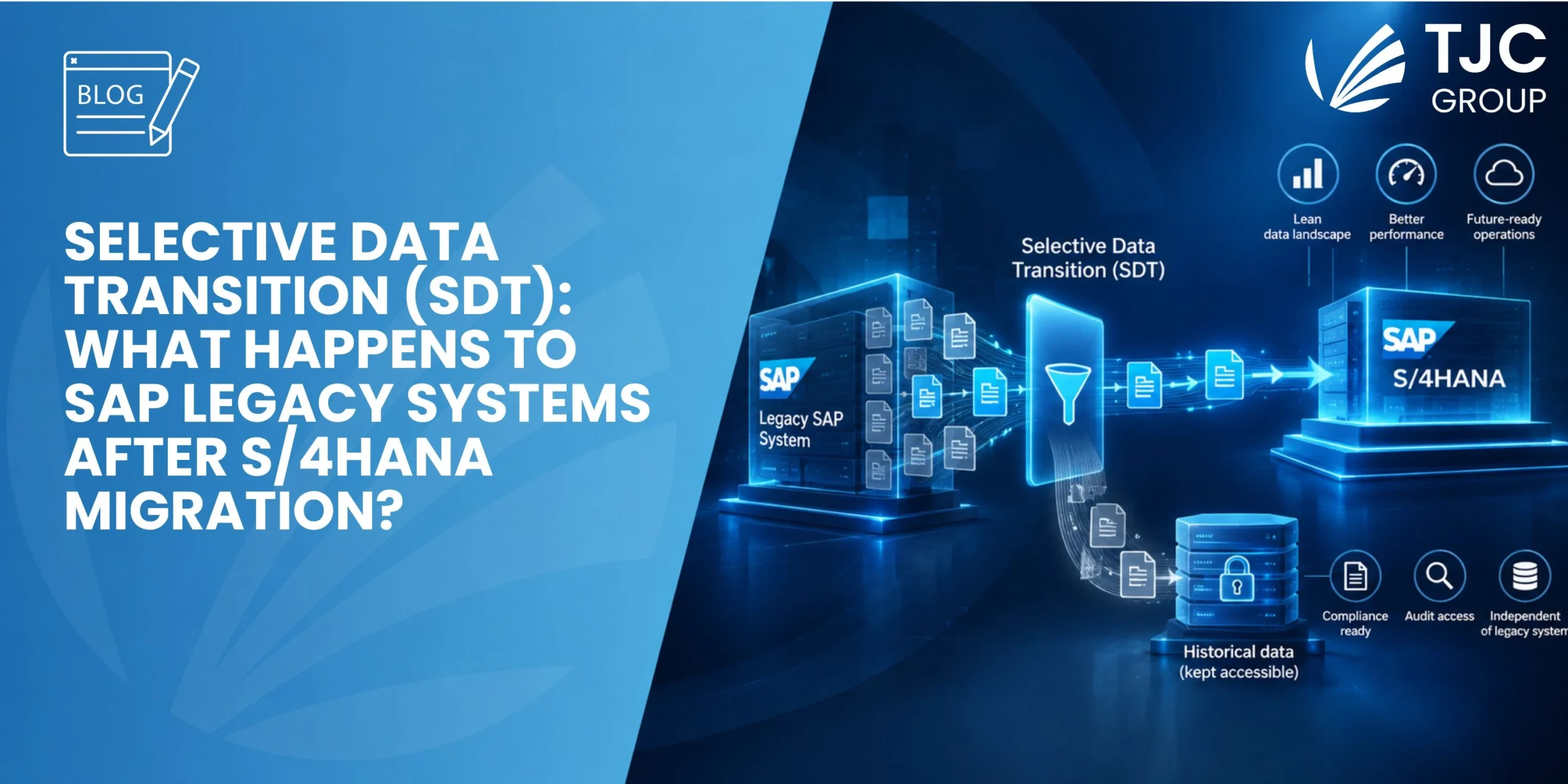
The Selective Data Transition (SDT) approach is often preferred. SAP provides a roadmap for lean SDT, free of charge, through SAP Cloud ALM. This hybrid approach allows organisations to selectively migrate only the data they need whilst decommissioning the rest.
Regardless of the approach chosen, decommissioning legacy systems remains a necessary step. A comprehensive guide to navigating legacy system decommissioning can help organisations plan effectively.
How TJC Group supports legacy system decommissioning
With over 25 years of expertise in data volume management, TJC Group has developed a proven methodology for decommissioning legacy SAP and non-SAP systems. Our approach follows a structured, phased process:
Assessment and planning: We analyse your legacy landscape, identify data retention requirements, and develop a tailored decommissioning roadmap.
Data extraction: We extract 100% of legacy data, including transactional data, documents, and master data, as a complete tax archive.
Data loading and validation: Extracted data is loaded into our cloud-based legacy system application, ELSA, and thoroughly validated to ensure completeness and accuracy.
System shutdown: Once data accessibility is confirmed, the legacy system is permanently decommissioned.
To understand the broader context of data management in this process, explore our guide on SAP Information Lifecycle Management (ILM) and learn about the true cost of keeping legacy systems and data.
A quick overview of ELSA by TJC Group
ELSA by TJC Group is a cloud-based (or on-premises) solution that provides straightforward access to extracted legacy data, even for users unfamiliar with SAP GUI transactions. It preserves vital links between data points, enabling organisations to continue running audits, generating reports, and retrieving historical information long after the legacy system has been shut down.
One of ELSA’s unique features is that extracted data can be easily accessed both before and after migrating to S/4HANA, ensuring business continuity throughout the transformation process. Additionally, ELSA integrates with data lakes and business intelligence platforms, turning historical data from a burden into a valuable resource.
Key takeaways
Decommissioning legacy systems is not a peripheral activity in your S/4HANA migration, it is a strategic necessity. Here are the essential points to remember:
Start decommissioning early: Begin planning your legacy system decommissioning 12 to 18 months before your target S/4HANA migration date to allow sufficient time for data extraction and validation.
Quantify the costs of inaction: Calculate the true cost of maintaining legacy systems, including licensing, infrastructure, personnel, and security risks, to build a compelling business case for decommissioning.
Prioritise compliance and security: Ensure your decommissioning approach meets all tax, audit, and data privacy requirements whilst eliminating the cybersecurity risks associated with unpatched legacy systems.
Think beyond migration: Decommissioning is not just about facilitating S/4HANA migration, it is about building a sustainable, cost-effective, and compliant data management foundation for the future.
If you are planning on decommissioning legacy systems for your S/4HANA migration, we are here to help. Contact us today for more information!