



Author: Thierry Julien, CEO, TJC Group
Migrating from SAP ECC to S/4HANA is not a simple upgrade – it is a full system conversion. For companies established in France, the migration has a direct impact on how the French electronic accounting file (or Fichier des Écritures Comptables -FEC) must be generated. Getting this wrong can lead to non-compliant audit files, penalties, and unnecessary risk during a tax audit. This article outlines the best practices for producing compliant FEC files before, during, and after an S/4HANA migration.
Table of contents
- Introduction
- Why the move to S/4HANA matters for FEC compliance
- How to generate FEC files across the migration timeline
- Why generating FEC on S/4HANA for pre-migration periods is not recommended
- What to do when the original ECC system is no longer available
- Conclusion and key recommendations
- Sources of information
Introduction
The Fichier des Écritures Comptables (FEC) is a mandatory audit file that all companies established in France must be able to provide to the French Tax Administration (DGFiP) in the event of a tax audit. It contains all accounting journal entries for a closed fiscal year, along with the opening balance, and must comply with the format defined by Article A47 A-1 of the French Tax Code (Livre des Procédures Fiscales). Non-compliance can result in penalties of up to €5,000 per fiscal year, and is a negative signal for the auditor that will have consequences.
When a company migrates from SAP ECC to SAP S/4HANA, the FEC generation process requires careful planning. The transition between the two systems is classified as a system conversion — not a simple upgrade — meaning the accounting software environment fundamentally changes. SAP ECC and SAP S/4HANA are different products, not different versions of the same product. This has significant implications for how and where FEC files should be produced.
For a detailed overview of what the FEC is and how it is generated in SAP, see our article: How to generate the Fichier des Écritures Comptables (FEC) in a few words.
Why the move to S/4HANA matters for FEC compliance
Moving from SAP ECC to SAP S/4HANA is not merely a technical upgrade. It is a conversion to a new ERP platform with a different data model, a different database (SAP HANA), and often a different chart of accounts structure. SAP itself classifies this transition as a system conversion, as documented in its S/4HANA conversion guides.
This distinction matters because the FEC must accurately reflect the accounting data as it existed in the system that was the company’s active accounting tool at the time the entries were recorded.
A system conversion can introduce changes to the underlying data, including:
- Renumbering of customer and supplier master records due to the introduction of the SAP Business Partner model in S/4HANA.
- Changes to the chart of accounts, for example through account merging, renaming, or restructuring to align with the simplified S/4HANA data model.
- Modifications to document numbering sequences, which may affect the sequential integrity required by the FEC format.
The French Tax Administration’s official guidance (BOI-CF-IOR-60-40-20, Section VII-A, §400) specifically addresses the case of a software migration occurring mid-fiscal year. It confirms that two separate FEC files — one from each system — are acceptable under defined conditions.
How to generate FEC files across the migration timeline
To illustrate the correct approach, let us consider a migration from ECC to S/4HANA that takes place at a date t during fiscal year Y.
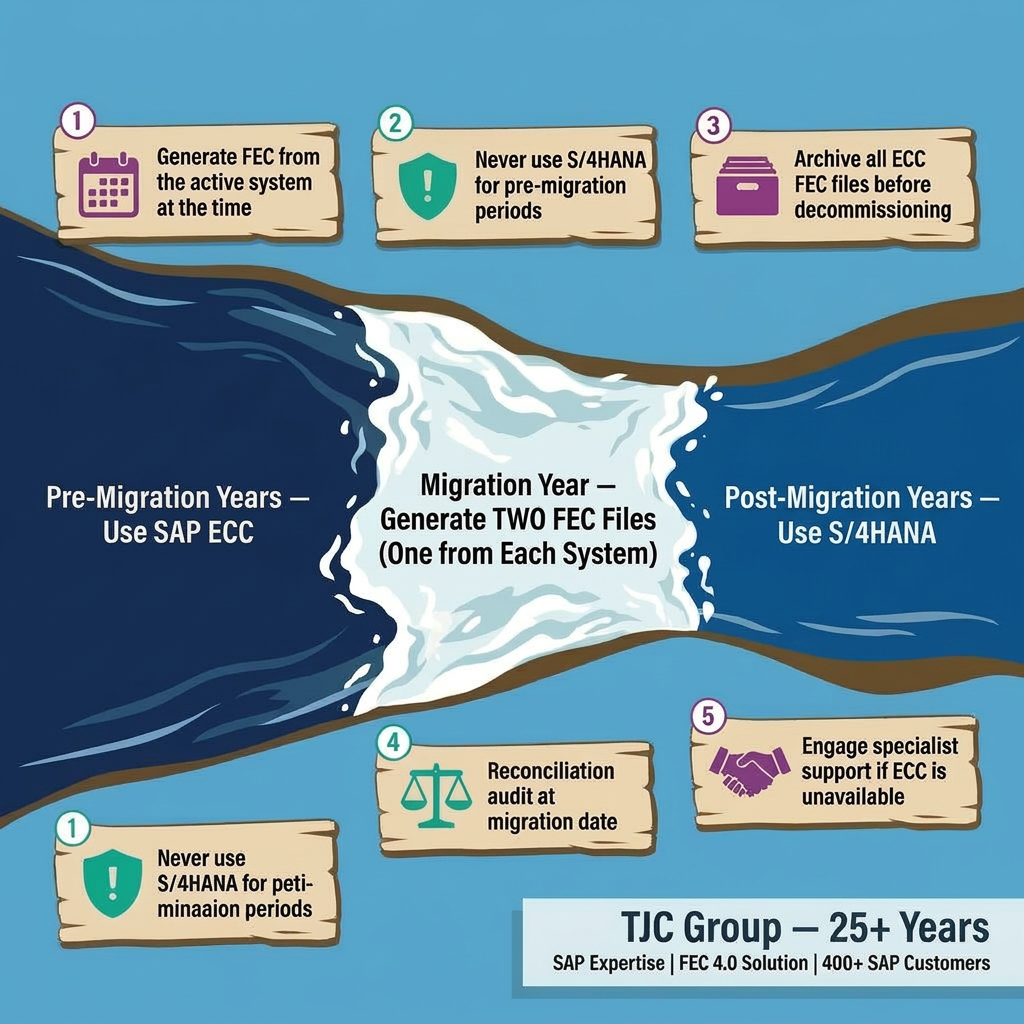
- Fiscal years before the migration. For all fiscal years prior to Y, the FEC must be generated from the SAP ECC system. This is the system that was the active accounting platform during those periods, and it holds the original, unaltered accounting data. If the FEC as not been generated at fiscal year closing, when running data archiving, make sure to extract FEC from online and archived data.
- Fiscal years after the migration. For all fiscal years after Y, the FEC must be generated from the SAP S/4HANA system. From this point onwards, S/4HANA is the company’s accounting system of record.
- The fiscal year of the migration. The fiscal year in which the migration occurs, that is year Y, requires special attention. The FEC for this year must be composed of two separate files:
- A first FEC file generated on SAP ECC, covering the period from the start of the fiscal year up to date t (the migration date).
- A second FEC file generated on SAP S/4HANA, covering the period from date t to the end of the fiscal year.
Together, these two files constitute the complete FEC for the year of migration.
In accordance with the BOFiP guidance, both files must be submitted simultaneously to the tax auditor, and each must comply with the format defined by Article A47 A-1 of the LPF.
Important remark: For the second file (generated on S/4HANA), the first entries must correspond to the carry-forward balances (écritures d’à nouveau) from the first part of the fiscal year. If the migration involves a change to the chart of accounts or other accounting references, tables of correspondence and accounting reconciliation between the two systems must also be provided to the auditor.
It is strongly advisable to carry out a reconciliation audit at the migration date to verify that data is consistent between the two systems at the point of transition.
Why generating FEC on S/4HANA for pre-migration periods is not recommended
A common question arises: can the FEC for pre-migration periods simply be generated from S/4HANA, since the historical data was migrated into the new system?
This is not a recommended practice, for several important reasons:
- The migration process may have altered the data. Customer and supplier numbers, account codes, and document references may have been changed during conversion. The FEC must reflect the data as it was recorded in the original system — not as it appears after transformation.
- S/4HANA was not the company’s accounting system during those periods. Generating an audit file from a system that was not the active accounting platform at the time creates a compliance risk.5
- The French Tax Administration expects the FEC to be produced from the system that held the accounting records at the relevant time. Generating it from a different system undermines the audit trail and the principle of data traceability.
TJC Group’s FEC solutions cannot guarantee the outcome of such practices. The integrity of the FEC depends on the integrity of the source data, and post-migration data may not faithfully represent the original accounting records.
What to do when the original ECC system is no longer available
In practice, there are situations where the recommended approach cannot be followed. The migration may have permanently altered the ECC system, or the company may have already decommissioned the original ECC environment.
In these circumstances, and with no guarantee of result, TJC Group’s FEC solutions can be used to attempt to produce the required FEC files from the data available in S/4HANA. However, this comes with important caveats:
- The output must be carefully reviewed and validated, as data transformations during migration may have introduced inconsistencies.
- This approach cannot be the sole responsibility of software maintenance. It requires expert analysis and understanding of the specific data changes that occurred during the conversion.
- TJC Group can assist with consulting services to help assess the feasibility, identify data gaps, and support the production of the best possible FEC files given the constraints.
For organisations planning their migration, this underscores the importance of considering FEC compliance before decommissioning the legacy ECC system. Ensuring that all required FEC files have been generated and archived from ECC prior to shutdown is a critical step that should be included in any S/4HANA migration and data archiving strategy.
Conclusion and key recommendations
The migration from SAP ECC to S/4HANA is a transformative project, but it must not compromise your ability to meet French tax audit requirements. FEC compliance is a regulatory obligation that demands careful planning around the migration timeline.
Here are the key recommendations to follow:
- Always generate FEC files from the system that was active at the time. For pre-migration years, use ECC. For post-migration years, use S/4HANA. For the migration year, produce two files — one from each system.
- Do not rely on S/4HANA to produce FEC files for periods when ECC was the active system. Data transformations during conversion can compromise the accuracy and compliance of the output.
- Generate and archive all required FEC files from ECC before decommissioning the system. Once the legacy environment is shut down, producing compliant FEC files becomes significantly more difficult and uncertain.
- Perform a reconciliation audit at the migration date. Verify that carry-forward balances and accounting references are consistent between the two systems to ensure a seamless audit trail.
- Engage specialist support when needed. If the original ECC system is no longer available, TJC Group’s consulting services can help assess the situation and support the production of FEC files from S/4HANA data, while clearly communicating the limitations involved.
With over 25 years of expertise in SAP data management and tax compliance, TJC Group helps organisations navigate complex scenarios like these. Our FEC 4.0 solution, used by more than 400 SAP customers, is compatible with both SAP ECC and S/4HANA and simplifies the generation of compliant audit files. Contact us to discuss your specific migration and FEC compliance needs.
Sources of information
- Conversion Guide for SAP S/4HANA Cloud Private Edition. SAP. Link: https://help.sap.com/doc/8cec006e962a46049506bc10ed64f557/2025/en-US/CONV_PE2025.pdf
- Step-by-Step Guide for System Conversion with Integrated Toolchain. SAP help portal.Link: https://help.sap.com/docs/erp-transformation-with-itc/buildable-map/step-by-step-guide-for-system-conversion-with-sap-s-integrated-toolchain?utm_source=chatgpt.com&locale=en-US
- CF – Procédures de rectification et d’imposition d’office – Contrôle des comptabilités informatisées – Format du fichier des écritures comptables. Bulletin Officiel des Finances Publiques – impôts. Link: https://bofip.impots.gouv.fr/bofip/9028-PGP.html/identifiant%3DBOI-CF-IOR-60-40-20-20170607?utm_source=chatgpt.com#Cas_particuliers_16.
- Business Partner Approach (Customer/Supplier Integration). SAP help portal. Link: https://help.sap.com/docs/SAP_S4HANA_ON-PREMISE/74b0b157c81944ffaac6ebc07245b9dc/25b46c8241fd4852bf7876d87bed8fd0.html
- Chart of Accounts Conversion. SAP Documentation. Link: https://help.sap.com/saphelp_lt100/helpdata/en/af/31c15839904ef2af96d3e94447a2ed/frameset.htm
Frequently asked questions
Q1. Is it advisable to create the FEC file on S/4HANA for pre-migration periods?
Answer:
No, this is not a recommended practice. The FEC must reflect the accounting data as it existed in the system that was the company’s active accounting tool at the time the entries were recorded. During the migration from ECC to S/4HANA, data transformations — such as renumbering of customers and suppliers, changes to the chart of accounts, or modifications to document sequences — can alter the underlying records. Generating a FEC from S/4HANA for periods when ECC was the active system creates a compliance risk and undermines the audit trail. TJC Group’s FEC solutions cannot guarantee the outcome of such practices.
Q2. What happens if my company has already decommissioned the ECC system before generating all required FEC files?
Answer:
When the legacy system is no longer accessible, options become limited. It may still be possible to extract FEC files using the migrated data in S/4HANA, but the results cannot be guaranteed due to potential data alterations during conversion. TJC Group’s consulting team can evaluate your specific situation and help determine the most viable path forward.
If the organisation has already decommissioned the ECC system with an application such as ELSA by TJC, it will be possible to create a FEC file from the original ECC data remaining tax compliant.
Q3. How should the FEC be handled for the fiscal year in which the migration takes place?
Answer:
The fiscal year of the migration requires two separate FEC files. The first file must be generated from SAP ECC, covering the period from the start of the fiscal year up to the migration date. The second file must be generated from SAP S/4HANA, covering the period from the migration date to the end of the fiscal year. Both files must be submitted simultaneously to the tax auditor and comply with the format defined by Article A47 A-1 of the French Tax Code. A reconciliation audit at the migration date is strongly recommended to ensure data consistency between the two systems.
Q4. How can TJC Group help with FEC compliance during an S/4HANA migration?
Answer:
TJC Group’s FEC 4.0 software runs on both ECC and S/4HANA, enabling organisations to generate compliant audit files regardless of which system is in use. When circumstances are more complex, our consultants can step in to analyse the data, flag potential issues, and support the file production process.