



Author: Patchanok Kluabkaew, B2G Team Lead at TJC Group
Artificial intelligence could change how organisations manage e-invoicing and tax compliance. Instead of teams manually investigating every rejected invoice or reviewing regulatory updates one by one, AI can help identify what needs attention and explain why — with some capabilities already visible in SAP’s publicly documented tools for tax and compliance.
Introduction
Electronic invoicing is making tax compliance faster, more connected, and increasingly dependent on data flowing correctly between ERP systems, business networks, service providers, and tax authorities.
Artificial intelligence could change how organisations manage that complexity. Instead of compliance teams manually investigating every rejected invoice, reviewing regulatory updates one by one, or searching through reports for unusual transactions, AI can help identify what needs attention and explain why.
Some of these flows are no longer theoretical. SAP’s public materials already describe AI capabilities for tax and compliance, including regulatory-change monitoring, e-invoicing error classification, anomaly detection in statutory reports, and recommendations for corrective action.
But there is an important distinction: AI can support compliance work, however it does not remove the need for accurate source data, established tax rules, human judgement, governance, and a reliable compliance platform such as SAP Document and Reporting Compliance.
AI is entering a compliance process that is already becoming more complex
E-invoicing is not simply the digital replacement of a paper invoice. Depending on the country, organisations may need to create structured electronic documents, validate specific tax fields, communicate with approved platforms or tax authorities, monitor submission statuses, correct rejected documents, and preserve evidence for future audits.
Statutory reporting creates another layer of requirements.
For multinational organisations, these processes may vary across dozens of legal entities and jurisdictions. Regulations change at different times, technical specifications evolve, and the underlying SAP landscape may contain different ERP versions, interfaces, master data structures, and local processes.
TJC Group’s guide to global e-invoicing and e-reporting explores the wider compliance landscape.
AI becomes interesting in this context because much of the workload is not simply about submitting a document. It is about identifying exceptions, understanding changes, finding the cause of an error, deciding what requires attention, and directing the right information to the right person.
What can AI already support in SAP tax and compliance?
Autonomous Compliance and Autonomous Enterprise
SAP introduced the concept of Autonomous Enterprise in May 2026 at SAPPHIRE Orlando. As described by SAP, “The Autonomous Enterprise brings together AI engagement, intelligent business execution, and a governed AI foundation to help organizations move from intent to action at scale.” In essence, this means putting AI agents to work alongside human teams to better manage all critical business activities.
The Tax and Compliance Assistant is SAP’s cornerstone for meeting the principles of the Autonomous Enterprise. The assistant includes 10 agents designed to support Finance teams in time-consuming or repetitive tasks.
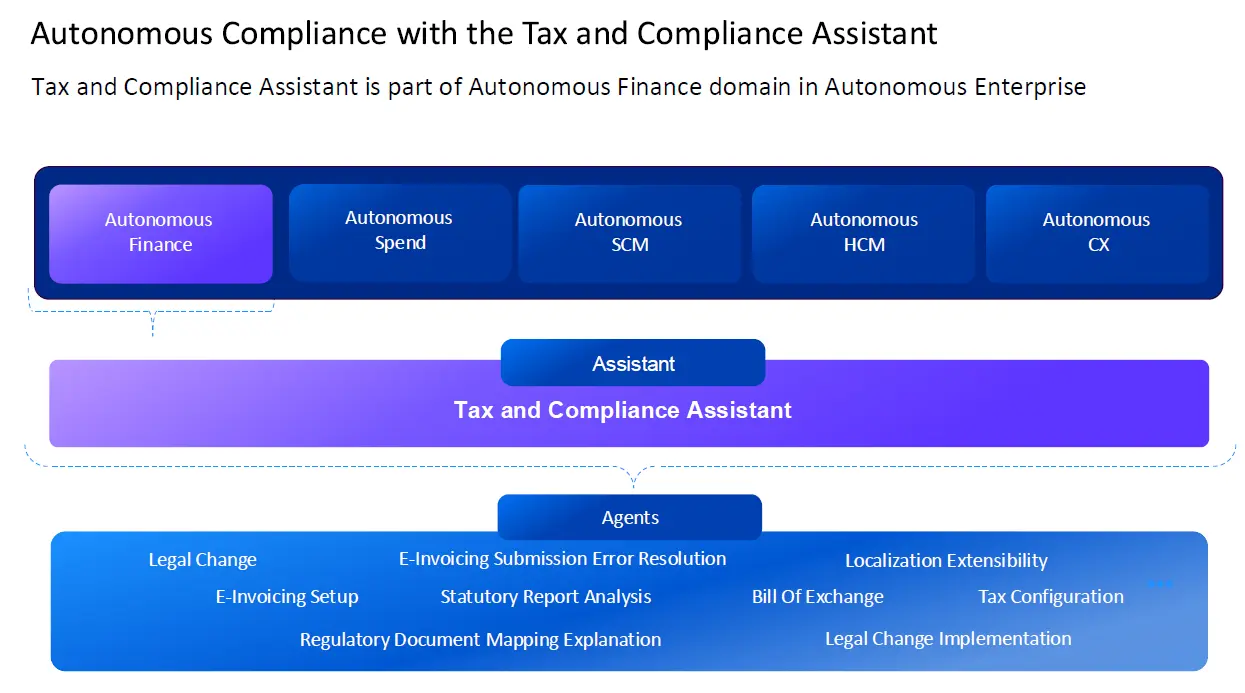
SAP Tax and Compliance Assistant
It is important to separate capabilities SAP publicly documents today from the broader possibilities discussed later in this article.
SAP publicly describes an SAP Tax and Compliance Assistant* covering areas such as regulatory changes, e-invoicing, statutory reporting, tax configuration, and tax classification. Availability and scope should still be checked for the organisation’s SAP environment and individual compliance scenario.
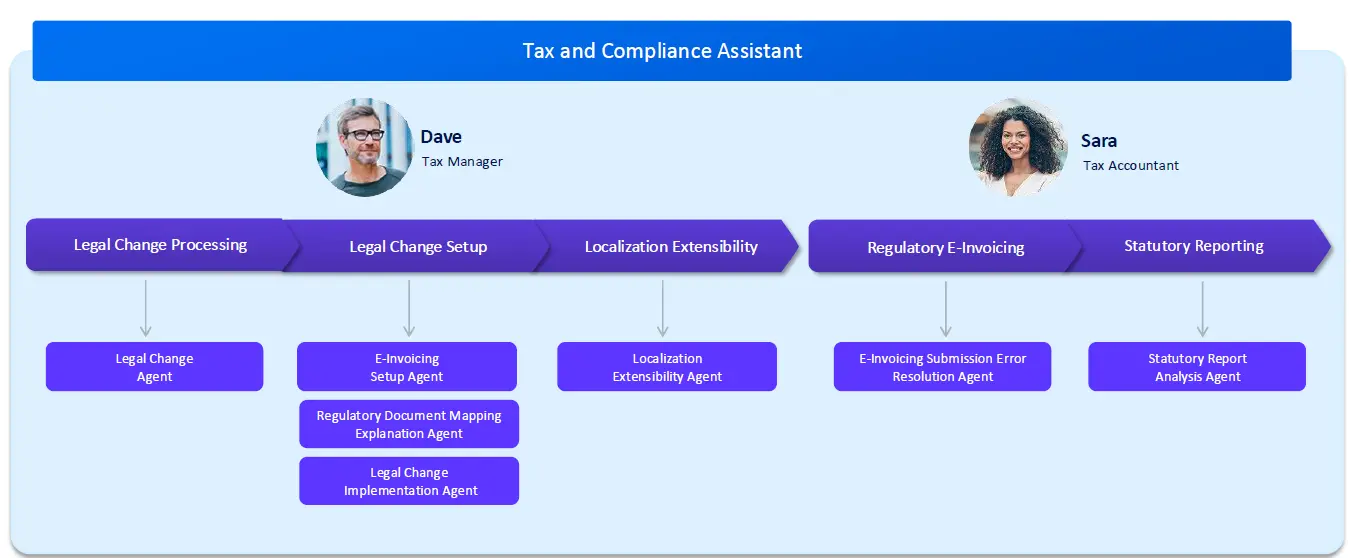
Among the capabilities SAP currently describes are:
- Monitoring legal and regulatory changes
- Classifying e-invoicing submission errors
- Helping resolve integration issues
- Providing guidance for master-data corrections
- Analysing VAT and statutory reports
- Identifying anomalies
- Recommending corrective actions
- Notifying relevant stakeholders
- Supporting guided compliance workflows
Please verify availability for your environment and your region with SAP or with TJC Group.
SAP also provides the Regulatory Change Manager, which gives organisations information about regulatory changes affecting SAP products and solutions. Joule can be used with Regulatory Change Manager to help users evaluate regulatory updates in the context of their SAP environment.
These public capabilities show where AI is already beginning to support tax and e-invoicing operations. The following sections look at what those capabilities could mean as organisations apply them more widely across compliance processes.
They should not, however, be interpreted as meaning that every capability is available for every country, SAP environment, or DRC scenario. Organisations should verify the current scope and availability for their own landscape.
Where could AI have the biggest impact on e-invoicing and tax compliance?
The wider opportunity goes beyond simply automating invoice submission. AI can potentially reduce the amount of time compliance teams spend finding problems, understanding them, and deciding what to do next.
Explaining e-invoicing errors
A rejected electronic invoice can create more work than the original submission. The team first needs to determine why it failed. The cause could be relatively simple, such as a missing tax identifier or incorrect master data. In other cases, the problem may sit deeper in the process, from an invalid invoice format or communication failure to a country-specific validation rule, an integration issue, or a mismatch between the SAP document and the submitted electronic document.
Traditional monitoring can tell the user that a document failed. AI can add another layer by helping classify the error, interpreting technical messages, and pointing the user towards a likely cause.
SAP publicly describes an E-Invoicing Submission Error Resolution Agent that can categorise submission errors, support the resolution of integration issues, and guide users through master-data corrections.
The practical value is not merely automation. It is reducing the time between “this invoice failed” and “this is what needs to be checked.” This could become increasingly useful as organisations manage SAP DRC across more countries and SAP systems.
Detecting anomalies before they become compliance problems
Not every compliance problem produces an immediate system error. An invoice can pass technical validation and still contain information that deserves attention. An unusual VAT amount, a sudden change in transaction volumes, repeated corrections from one legal entity, an unexpected pattern in tax codes, or a sharp increase in rejected documents may all warrant investigation.
AI-based anomaly detection can help identify these patterns across larger data sets.
SAP’s public Tax and Compliance Assistant material describes statutory-report analysis that can flag anomalies and recommend corrective actions. This changes the role of monitoring. Instead of relying only on predefined checks, teams can also use AI to surface patterns that may not have been obvious in advance. That does not mean an anomaly is automatically an error. AI can identify what looks unusual, but tax and finance professionals still need to determine whether it represents a compliance issue.
AI could also help teams decide which exceptions deserve attention first. In a high-volume environment, a repeated error affecting hundreds of invoices, a deadline-sensitive statutory issue, or an unusual high-value transaction may require a faster response than an isolated low-risk exception.
Making regulatory change easier to understand
One of the hardest parts of international tax compliance is simply keeping up. Governments regularly change e-invoicing mandates, reporting requirements, technical specifications, invoice schemas, validation rules, tax treatments, submission procedures, and compliance deadlines.
For a multinational organisation, the question is not only: What changed? It is also: Does this change affect us?
SAP’s Regulatory Change Manager provides information on regulatory changes affecting SAP products and solutions. SAP also publicly documents the use of Joule to help compliance and IT professionals evaluate these updates in the context of their SAP environment.
AI can make regulatory monitoring more useful by helping teams summarise a change, identify potentially affected processes or systems, and direct the information to the relevant stakeholders. Over time, the direction of travel is likely to move from simply notifying teams that a regulation has changed towards helping them understand the operational impact of that change.
Human review remains essential. Legal requirements still need to be validated against authoritative government and tax-authority sources, particularly where a change affects filing obligations, deadlines, or tax treatment.
Supporting error and exception classification
Compliance teams often spend significant time identifying what type of error or exception they are dealing with before they can start resolving it.
AI can help classify these cases according to their likely cause. A failed e-invoice, for example, may be caused by master-data issues, an integration failure, an incorrect format or schema, a regulatory validation error, or inconsistent tax data. Other cases may not fit neatly into one category and may need manual investigation.
Classification can make downstream workflows more efficient. Instead of every failed document entering the same queue, cases can be grouped according to likely cause, priority, jurisdiction, or the team responsible for resolving them. This becomes particularly useful when transaction volumes are high.
The objective is not to allow AI to make every compliance decision autonomously. It is to reduce the amount of manual sorting required before a qualified person reviews the issue.
From monitoring to workflow automation
The next step is connecting AI analysis with workflows. Consider a rejected e-invoice. In a largely manual process, someone first needs to notice the failed status, open the error, investigate what happened, contact another team if necessary, correct the master data or configuration, submit the document again, and then monitor the result.
AI and workflow automation could compress parts of this process. An AI-supported workflow might classify the failure, identify a likely cause, collect the relevant context, recommend a corrective action, and route the case to the person authorised to review it.
Automation should follow the level of risk and authority involved. Correcting an obvious formatting problem is different from changing the tax treatment of a transaction, amending information that will appear in a statutory report, or making a correction that could affect an organisation’s tax liability.
How AI could support statutory reporting preparation
Statutory reporting involves another large review workload. Before a report is submitted, teams may need to confirm completeness, check tax values, compare results with previous periods, investigate missing transactions, reconcile figures, and review unusual entries or unexpected changes.
AI can help focus that review. Rather than asking a person to inspect every line with the same level of attention, an AI-supported process can identify areas that appear unusual and explain why they were highlighted.
SAP publicly describes a Statutory Report Analysis Agent that analyses VAT and statutory reports, detects anomalies, and recommends corrective actions for users to review. The value is in helping specialists spend more time investigating genuine exceptions and less time manually searching for them.
AI will not fix poor compliance data
The effectiveness of AI depends on the data behind it.
An AI assistant cannot reliably explain or automate a compliance process if the underlying invoice contains incorrect VAT numbers, duplicate or inconsistent business partners, missing tax fields, invalid addresses, incorrect tax codes, unclear invoice references, or inconsistent country data.
This is the same problem organisations already face with SAP DRC. TJC Group’s guidance on SAP DRC integration and data quality explains why inaccurate or incomplete source data can result in failed validations and rejected electronic documents.
AI makes this dependency more important, not less. If an automated workflow is allowed to recommend or initiate actions, the organisation needs confidence in the information supporting those decisions. Data quality, ownership, business context, permissions, and traceability therefore remain part of AI readiness.
The same principle applies more broadly to SAP AI agents and governed ERP data: giving an agent access to more information is not enough if that information cannot be trusted or interpreted correctly.
Human oversight becomes more important as automation increases
AI can reduce manual work, but tax compliance remains a high-consequence business process. An incorrect recommendation could affect tax liabilities, statutory submissions, customer invoices, reporting obligations, audit evidence, or regulatory compliance. Organisations therefore need to define where humans remain responsible.
A useful way to think about AI involvement is through three levels:
| Level | Role of AI | Human involvement |
|---|---|---|
| Inform | Explain errors, summarise regulatory changes, surface anomalies | User reviews the information |
| Recommend | Suggest a corrective action or next step | User approves or rejects the recommendation |
| Act | Execute an approved, well-defined action | Human oversight is applied according to risk and policy |
This is an illustrative governance model, not an SAP-defined framework.
The appropriate level should depend on the risk of the process, confidence in the data, regulatory requirements, and the organisation’s internal controls. For high-impact tax decisions, human review should remain part of the process.
Compliance teams will need to govern AI as well as tax
As AI becomes more involved in compliance workflows, organisations will need answers to a new set of questions. For example:
- What information was used to make the recommendation?
- Which AI agent or workflow generated it?
- Was the underlying invoice, tax, or master data current?
- Who approved a tax or reporting correction?
- Can the organisation explain why an electronic document was changed or resubmitted?
- What happens when the AI is uncertain about a tax or compliance issue?
- Which corrections can be automated?
- Which corrections require tax, finance, or compliance approval?
- Is there sufficient evidence for an auditor to trace the resulting action?
- How are changes to the AI workflow tested and approved?
The objective should not be maximum autonomy. It should be controlled automation, where AI reduces routine effort while the organisation retains accountability for compliance decisions.
Where TJC Group fits
The growth of AI does not change the basic requirements of an e-invoicing or tax-compliance programme. Organisations still need reliable SAP data, correctly designed compliance processes, clear responsibilities, current regulatory information, and a platform capable of supporting the relevant electronic-document and reporting requirements.
TJC Group is an official SAP DRC reseller and implementation partner, with decades of experience in SAP tax, audit, reporting, and data-compliance requirements.
For organisations that need a broader introduction to the solution before considering AI use cases, TJC Group’s SAP DRC guide covers the wider role of Document and Reporting Compliance across e-invoicing and statutory reporting. Its work around SAP DRC and global e-invoicing and e-reporting provides the compliance foundation on which new automation and AI capabilities can be assessed.
AI should not be treated as a replacement for that foundation. Its value comes from helping tax, finance, and IT teams understand exceptions faster, identify unusual activity, respond to regulatory change, and automate appropriate parts of established compliance workflows.
What should SAP teams do now?
Organisations do not need to wait for every future AI capability before improving their compliance processes. The more useful preparation is to strengthen the environment AI will depend on. SAP teams can start by asking:
- Is our e-invoicing and statutory reporting data reliable?
- Do we know which teams own different types of compliance errors?
- Can we identify and monitor failed electronic documents effectively?
- How do we currently track regulatory changes?
- Which compliance tasks consume the most manual effort?
- Which decisions require tax expertise or formal approval?
- Are our audit trails sufficient to explain changes and corrections?
- Which repetitive, low-risk activities could benefit from AI assistance?
These questions help organisations identify where AI can provide practical value rather than adopting automation simply because it is available.
Conclusion
AI could change tax compliance less by replacing existing systems and more by changing how people interact with them. Instead of manually searching for every error, reviewing every transaction with equal attention, or interpreting each regulatory update from scratch, tax and finance teams can increasingly use AI to identify what matters and understand what requires action.
Some of that shift is already visible in SAP’s publicly documented AI capabilities for tax and compliance. The longer-term opportunity is broader: compliance processes that detect issues earlier, explain exceptions more clearly, route work intelligently, and automate appropriate actions while keeping people responsible for the decisions that matter.
For organisations, the priority should not be AI for its own sake. It should be building reliable data, governed processes, and clear controls so that AI can be introduced where it genuinely improves compliance. Contact TJC Group today to discuss how to prepare your SAP environment for AI.
FAQ's
Q1. Is AI already being used in SAP tax and compliance?
Answer:
SAP publicly documents AI capabilities for tax and compliance, including regulatory-change monitoring, e-invoicing error resolution, statutory-report analysis, anomaly detection, and recommended corrective actions. The availability and scope of these capabilities should be checked for the organisation’s SAP environment and individual compliance scenarios.
Q2. Can AI automatically fix rejected e-invoices?
Answer:
AI can help classify errors, identify likely causes, and support corrective workflows. SAP publicly describes capabilities that support integration-issue resolution and guide users through master-data corrections. This does not mean every rejected invoice can or should be corrected automatically. Organisations still need to define which actions can proceed with automation and which require human review.
Q3. Can AI detect tax and reporting anomalies?
Answer:
Yes. AI can identify patterns or values that differ from expected behaviour, and SAP publicly describes anomaly detection for VAT and statutory report analysis. An anomaly is not automatically an error — it indicates that the transaction or pattern may deserve further investigation.
Q4. Can AI monitor regulatory changes?
Answer:
AI can support regulatory-change monitoring by helping users identify, summarise, and assess changes. SAP already provides Regulatory Change Manager and publicly documents Joule integration for evaluating regulatory updates. Legal and compliance teams should still validate important requirements against authoritative regulatory sources.
Q5. Will AI replace tax and compliance professionals?
Answer:
AI is more likely to change how their time is used. Routine classification, monitoring, summarisation, and exception analysis can increasingly be assisted by AI, while specialists remain responsible for judgement, interpretation, approvals, governance, and higher-risk compliance decisions.
Q6. Does adopting AI remove the need for SAP DRC?
Answer:
No. AI and SAP DRC solve different parts of the problem. DRC provides the framework for supported electronic-document and statutory-reporting processes, while AI can help users understand, monitor, and automate parts of the work around those processes.