



Author: Priyasha Purkayastha, Global Content Manager, TJC Group
With over 90 countries now enforcing or preparing e-invoicing mandates, building a cohesive global e-invoicing strategy is no longer optional. However, many organisations still approach e-invoicing on a country-by-country basis, creating fragmented systems that are costly to maintain and difficult to scale. So, what’s the way forward? Let’s explore the integration strategies that can help your organisation move from reactive compliance to a unified, future-proof approach for e-invoicing and reporting.
Table of contents
Introduction
E-invoicing has evolved from a niche regulatory requirement to a global movement, reshaping how businesses handle financial transactions. What began with Latin American mandates and Italy’s trailblazing B2B requirement in 2019 has now expanded across Europe, Asia-Pacific, the Middle East, and Africa.
For multinational organisations, this rapid expansion creates a pressing challenge: how do you build a global e-invoicing strategy that satisfies diverse national requirements without creating a tangled web of disconnected systems? The answer lies in a well-planned integration strategy that places your ERP system at the centre and treats compliance as a unified, scalable capability rather than a series of isolated projects.
Through this article, we help you examine the key integration strategies that forward-thinking organisations are adopting to stay ahead of the compliance curve while driving operational efficiency.
Key pillars of a scalable global e-invoicing strategy
Building a truly scalable global e-invoicing strategy requires focusing on several foundational principles:
Centralised ERP integration
The most effective e-invoicing architectures are those that connect directly to the organisation’s core ERP system. Rather than extracting data into external platforms, a centralised integration ensures that invoice data is generated, validated, and transmitted from a single source of truth, eliminating data replication and reducing the risk of inconsistencies.
Automated compliance logic per jurisdiction
A scalable solution must be able to apply country-specific rules, starting from formats, digital signatures, validation checks, and submission protocols, automatically, without requiring manual configuration for each transaction. This means investing in a platform that maintains an updated library of regulatory requirements across all relevant jurisdictions.
Unified monitoring and reporting
A centralised dashboard that provides real-time visibility into e-invoicing status across all countries is invaluable. It enables finance and IT teams to identify issues quickly, track submission statuses, and generate compliance reports without switching between multiple systems.
Future-proof architecture
Regulations change frequently, hence it is quintessential that your global e-invoicing strategy accommodates new countries, updated formats, and evolving requirements, such as the shift towards real-time reporting, without requiring a fundamental redesign of your infrastructure.
Practical steps to build your integration roadmap
Translating these principles into action requires a structured approach. Here is a practical roadmap for building your global e-invoicing integration strategy:
Phase 1: Assess and prioritise
Map all current and upcoming e-invoicing mandates relevant to your operations. Identify which countries have the most imminent deadlines and the highest transaction volumes. This analysis will help you prioritise implementation efforts.
Phase 2: Evaluate your current architecture
Audit your existing ERP landscape, including the number of instances, versions, and any legacy systems. Identify gaps between your current capabilities and the requirements of a centralised e-invoicing solution.
Phase 3: Select a scalable platform
Choose an e-invoicing solution that integrates natively with your ERP, supports multiple country formats, and can scale as new mandates emerge. For SAP environments, SAP DRC offers a robust, future-proof foundation.
Phase 4: Implement iteratively
Begin with your highest-priority countries, validate the integration, and then expand progressively. Each new country should be an incremental addition to the existing framework rather than a standalone project.
Phase 5: Monitor and adapt
Establish ongoing governance to track regulatory changes, monitor submission statuses, and update compliance logic as requirements evolve.
Overcoming ERP integration challenges
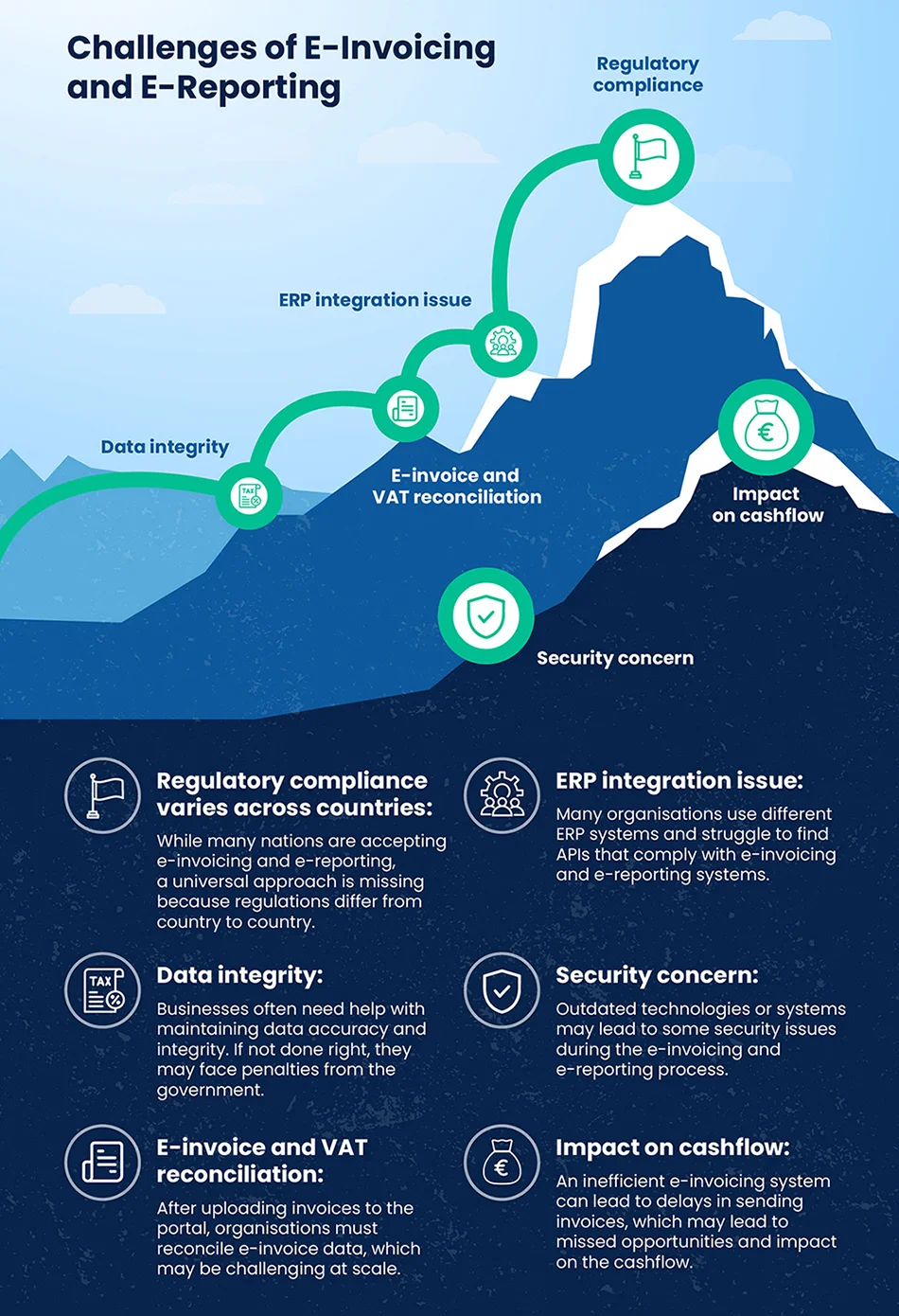
One of the most significant hurdles in implementing a global e-invoicing strategy is ERP system integration. Organisations often operate multiple ERP instances, legacy systems, or different software versions across their subsidiaries. Integrating these diverse systems with e-invoicing requirements introduces challenges around data structures, communication protocols, and format compatibility.
ERP systems must be connected to APIs and submission platforms that are customised to comply with each country’s e-invoicing and e-reporting structure. However, the diversity of data formats, from XML-based standards like UBL and CII to country-specific schemas, means that data often needs to be transformed, mapped, or cleansed before it can be exchanged accurately.
To address these challenges, organisations should prioritise solutions that are natively integrated with their ERP environment rather than relying on middleware or bolt-on tools. Native integration reduces latency, minimises data transformation errors, and ensures that compliance logic is applied at the point of invoice creation rather than as an afterthought.
The role of SAP DRC in unified e-invoicing and reporting
SAP Document and Reporting Compliance (SAP DRC) represents a powerful foundation for a unified global e-invoicing strategy, specifically designed to handle e-invoicing and reporting requirements. The solution enables organisations to create, process, and monitor transactional documentation and periodic statutory reports in local legal formats.
It consists of two complementary components:
- SAP DRC on SAP S/4HANA and SAP ERP: Fully integrated with business processes, generating electronic documents and statutory reports without data replication.
- SAP DRC on SAP Business Technology Platform (BTP): Providing cloud-based scalability for electronic submission to tax authorities, either through SAP DRC cloud edition or customer-managed SAP Integration Suite tenants.
Want to learn more about SAP Document and Reporting Compliance? Click on the banner below:

Continuous transaction controls: A growing requirement
A critical trend shaping e-invoicing integration strategies is the rise of Continuous Transaction Controls (CTCs). Unlike traditional post-audit models where tax authorities review invoices after the fact, CTC models require businesses to submit invoice data to authorities in real time or near real time, either before or at the point of issuing the invoice to the buyer.
CTC models vary significantly by country. Some operate on a centralised basis, requiring suppliers to route e-invoices through a government platform that validates and forwards them. Others use a decentralised model, where suppliers send invoices directly to buyers whilst simultaneously reporting data to the tax authorities. Understanding these different models for Continuous Transaction Controls is essential for designing an integration architecture that can accommodate both approaches.
Conclusion
Building a resilient global e-invoicing strategy requires moving beyond reactive, country-by-country compliance. Centralise your approach in your core ERP system to ensure data consistency, reduce complexity, and enable scalability across jurisdictions.
Adopt an iterative rollout; prioritise countries by deadline and transaction volume, then expand progressively. Each new mandate should strengthen your existing framework rather than add another disconnected system.
Navigating the complexity of global e-invoicing regulations requires deep expertise. TJC Group, with over 25 years of experience in data management and SAP compliance solutions, helps organisations design and implement scalable e-invoicing strategies that turn regulatory complexity into operational advantage.
Contact us to learn how we can support your journey!
Frequently asked questions (FAQs)
Q1. What is a global e-invoicing strategy?
Answer:
A global e-invoicing strategy is a unified approach to managing electronic invoicing compliance across multiple countries and jurisdictions from a single, integrated framework. Rather than implementing separate solutions for each country, it centralises e-invoicing processes within the organisation’s core ERP system, enabling scalability and consistency.
Q2. Why is e-invoicing becoming mandatory worldwide?
Answer:
Governments are mandating e-invoicing to close VAT gaps, reduce tax fraud, and improve the efficiency of tax administration. Real-time access to structured invoice data enables tax authorities to verify transactions as they occur, rather than relying on periodic audits. The EU alone aims to recapture up to €18 billion annually through its ViDA initiative.
Q3. How many countries currently have e-invoicing mandates?
Answer:
Over 90 countries worldwide have e-invoicing mandates in place or are actively preparing to implement them. This number is expected to grow significantly by 2030, driven by initiatives such as the EU’s ViDA directive and the global shift towards Continuous Transaction Controls.
Q4. What are Continuous Transaction Controls (CTCs)?
Answer:
CTCs are regulatory models that require businesses to submit invoice data to tax authorities in real time or near real time, rather than after the fact. They can be centralised — where invoices pass through a government platform before reaching the buyer — or decentralised, where invoices go directly to the buyer with simultaneous reporting to authorities.
Q5. What formats are commonly used for e-invoicing?
Answer:
The most widely used e-invoicing formats include UBL (Universal Business Language), CII (Cross Industry Invoice), PEPPOL BIS 3.0, Factur-X, and XRechnung. Each country may mandate a specific format or accept several. A robust global e-invoicing strategy must be able to generate and process multiple formats automatically.
Q6. How does e-invoicing integrate with ERP systems?
Answer:
E-invoicing integrates with ERP systems through APIs and connectors that enable the automatic generation, validation, and transmission of electronic invoices. Natively integrated solutions — such as SAP DRC for SAP environments — embed compliance logic directly within business processes, eliminating the need for manual data extraction or external middleware.
Q7. What are the biggest challenges in implementing a global e-invoicing strategy?
Answer:
The primary challenges include managing diverse regulatory requirements across jurisdictions, integrating multiple ERP instances or legacy systems, handling varied data formats and submission protocols, and keeping pace with frequently changing regulations. Cross-departmental collaboration between finance, tax, IT, and legal teams is also essential for success.
Q8. What happens if a business fails to comply with e-invoicing mandates?
Answer:
Non-compliance can result in significant financial penalties, blocked VAT deductions, rejected invoices, and even legal consequences. Beyond the direct financial impact, non-compliance can disrupt business operations, damage supplier and customer relationships, and harm the organisation’s reputation.
Q9. How long does it take to implement a global e-invoicing solution?
Answer:
Implementation timelines vary depending on the complexity of the organisation’s ERP landscape, the number of countries involved, and the chosen solution. A phased approach — starting with the highest-priority countries and expanding iteratively — is generally recommended. Organisations should ideally begin planning 12 to 18 months before the first applicable mandate deadline.
Q10. Can small and medium-sized enterprises benefit from a global e-invoicing strategy?
Answer:
Absolutely. While the scale may differ, SMEs operating across borders face the same compliance requirements as larger organisations. Cloud-based e-invoicing solutions and scalable platforms like SAP DRC offer affordable options that grow with the business, helping SMEs avoid the cost and complexity of managing multiple country-specific tools.